
Rejuran Injection: Benefits, Procedure for Skin Rejuvenation
A rejuran injection is a polynucleotide-based treatment derived from salmon DNA that functions as a regenerative skin healer to improve elasticity, hydration, and acne scars through a recommended series of three to four sessions.
What is a Rejuran injection and how does it work for skin healing?
Rejuran is a polynucleotide (PN)-based injectable treatment derived from salmon DNA designed to improve skin quality and repair tissue. Unlike traditional dermal fillers that provide immediate volume, Rejuran functions as a regenerative “skin healer” by delivering long-chain DNA fragments into the dermis to support the skin’s natural repair processes.
The treatment works through several biological mechanisms to promote skin healing:
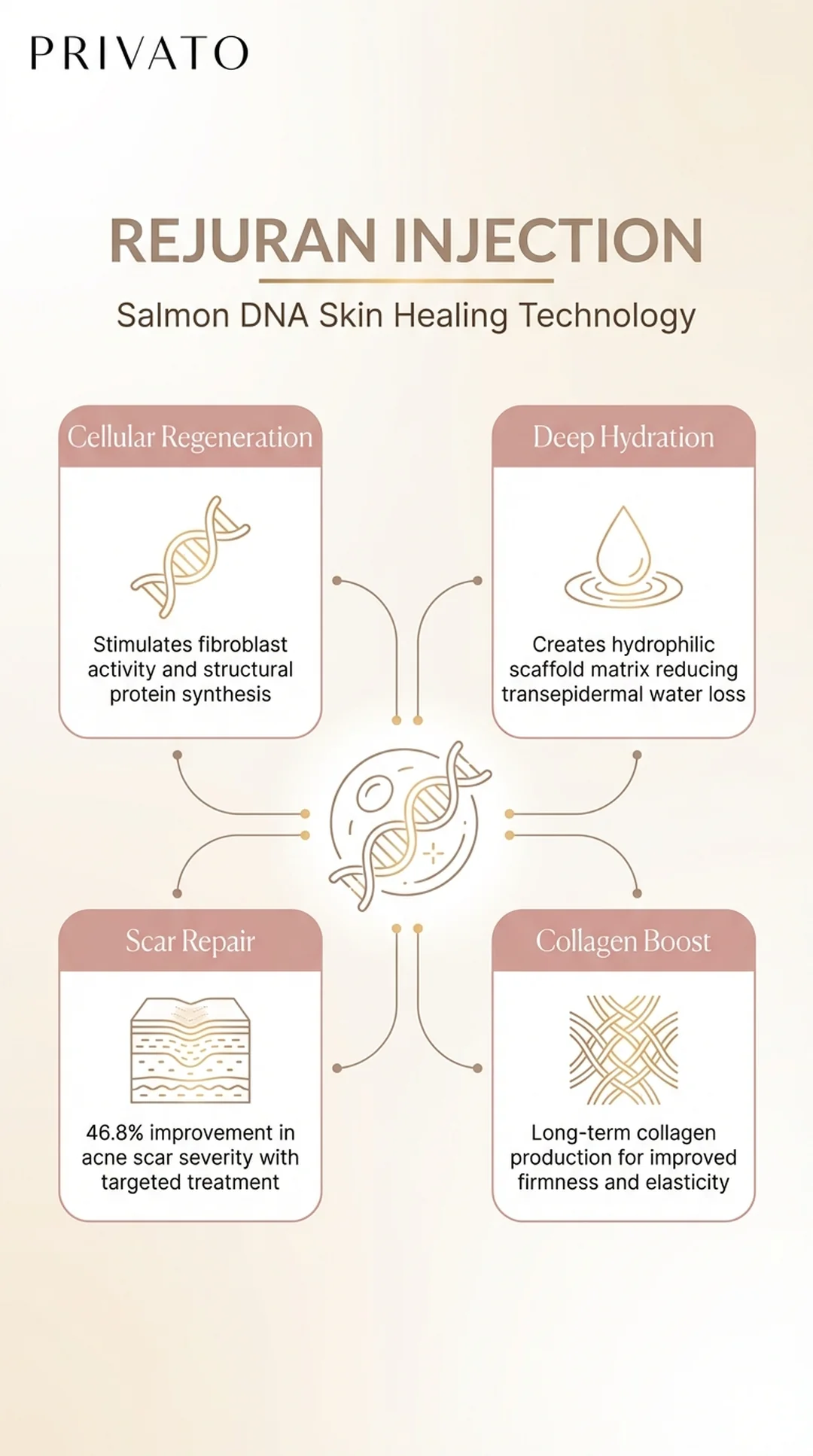
- Cellular Regeneration: It stimulates fibroblast activity, which increases the production of collagen and other structural proteins to remodel the extracellular matrix.
- Scaffold Formation: The polynucleotides create a hydrophilic, scaffold-like matrix that provides structural support and intense hydration to the skin.
- Barrier Repair: It helps reduce transepidermal water loss and increases filaggrin levels, strengthening the skin’s protective barrier and reducing inflammation.
- Tissue Remodeling: Rather than filling wrinkles instantly, it promotes gradual healing over several weeks, making it effective for treating fine lines, large pores, and atrophic acne scars.
The Science of Polynucleotides: How Salmon DNA Repairs Your Skin
Polynucleotides (PN) repair the skin by forming a hydrophilic scaffold-like matrix that supports fibroblast activity and the synthesis of structural proteins like collagen. This mechanism facilitates tissue remodeling and improves the organization of the extracellular matrix (ECM) over several weeks. Unlike traditional hyaluronic acid fillers that provide immediate volume, PN focuses on long-term cellular regeneration and barrier repair, which has been shown to increase filaggrin levels and reduce transepidermal water loss.
Understanding the role of PN (Polynucleotide) in cellular regeneration
Polynucleotides (PN) promote cellular regeneration by supporting fibroblast activity and the synthesis of structural proteins like collagen. These long-chain DNA fragments, often sourced from salmon or trout, create a hydrophilic scaffold-like matrix that improves the organization of the extracellular matrix (ECM). Rather than providing immediate volume like traditional fillers, PN facilitates tissue remodeling and repair over several weeks by enhancing the skin’s internal structural environment.
Rejuran vs. Traditional Skin Boosters: Key differences in composition
The primary difference in composition is that Rejuran is a polynucleotide (PN)-based injectable derived from salmon DNA, whereas traditional skin boosters typically consist of hyaluronic acid (HA).
While both treatments aim to improve skin quality, their chemical structures and biological functions differ:
- Rejuran (Polynucleotides): These are long-chain DNA fragments that create a scaffold-like matrix in the dermis. They are designed to promote tissue remodeling, support fibroblast activity, and provide long-term hydration through cellular repair.
- Traditional Skin Boosters (Hyaluronic Acid): These are polysaccharides that primarily function by binding water molecules. Their main effect is immediate, temporary smoothing and volumization of the skin surface rather than structural remodeling.
Some newer formulations, such as Rejuran HB plus, combine both PN and HA to provide the benefits of both substances simultaneously.
Primary Benefits of Rejuran Treatment for Different Skin Concerns
Effective treatment for acne scars and enlarged pores
Rejuran is an effective treatment for acne scars and enlarged pores by using polynucleotides (PN) to promote tissue remodeling and skin repair. Clinical data shows that Rejuran S is specifically designed for scar-focused injection patterns, while studies on PN-based gels have demonstrated significant improvements in atrophic acne scars:
- Acne Scars: In a study of 62 patients, 46.8% achieved at least a one-grade reduction in acne scar severity after four sessions at two-week intervals.
- Pores and Texture: Clinical signals from small case series indicate noticeable improvements in pore size and skin texture by week 12 following a series of four injections.
- Mechanism: The PN fragments form a scaffold-like matrix that supports fibroblast activity and collagen synthesis, leading to long-term structural repair rather than temporary filling.
- Protocol: For scar remodeling, experts recommend 3–6 sessions spaced four weeks apart, often using 30–32G needles for precise intradermal delivery.
Stimulating collagen production for natural anti-aging
Rejuran stimulates collagen production by supporting fibroblast activity and structural protein synthesis to improve the extracellular matrix (ECM). Unlike traditional dermal fillers that provide immediate volume, these polynucleotide (PN) injections act as a scaffold-like matrix to promote tissue remodeling and repair over several weeks. This regenerative process typically involves a series of three to four sessions spaced three to four weeks apart to achieve gradual improvements in skin firmness, elasticity, and texture.
Improving skin elasticity and overall hydration levels
Rejuran improves skin elasticity and hydration by delivering salmon-derived polynucleotides (PN) that support fibroblast activity and create a hydrophilic, scaffold-like matrix. These long-chain DNA fragments promote tissue remodeling and structural protein synthesis, such as collagen, rather than providing immediate volume like traditional fillers.
Key clinical and protocol details include:
- Hydration Mechanism: PN increases filaggrin levels and reduces transepidermal water loss (TEWL) to strengthen the skin barrier.
- Elasticity Benefits: In split-face trials, PN-treated areas showed superior elasticity and skin tone improvements compared to hyaluronic acid (HA) alone.
- Standard Protocol: For hydration and texture, experts recommend three sessions spaced four weeks apart, using approximately 2–4 mL of product per session.
- Maintenance: To sustain results in structural support and skin quality, maintenance treatments are often suggested every three months.
The Rejuran Injection Procedure: What to Expect During Your Session
The Rejuran injection procedure involves multiple small, intradermal injections of salmon-derived polynucleotides (PN) aimed at skin remodeling and hydration.
During a typical session, you can expect the following:
- Injection Technique: The practitioner uses a very fine needle (typically 30G to 34G) or a blunt cannula to deliver the product into the dermis or superficial subcutaneous plane.
- Dosing and Spacing: For standard hydration and texture improvement, small aliquots of 0.02–0.04 mL are injected at each site, with sites spaced approximately 3–5 mm apart.
- Volume and Duration: A single session usually involves 2–4 mL of the product and takes approximately 15 to 30 minutes, depending on the treatment area.
- Pain Management: While the many injection points can cause discomfort, some formulas like Rejuran HB plus contain lidocaine to reduce pain by approximately 53%.
- Immediate Aftereffects: It is normal to see small “micro-papules” (tiny bumps) at the injection sites, which typically subside within 24 to 48 hours.
Common injection techniques and targeted treatment areas
Injection techniques for Rejuran vary by the desired outcome and include intradermal micro-injections, deep-plane injections along ligaments, and blunt cannula delivery in the subcutaneous plane.
The specific protocols and targeted areas are as follows:
- Intradermal Hydration and Texture: This technique uses a 34G, 4 mm needle to deliver 0.02–0.04 mL per site with 3–5 mm spacing across the face to improve skin quality, pores, and fine lines.
- Structural Support: Practitioners use a 30G, 12 mm needle to inject 0.02–0.03 mL per site along the true and false retaining ligaments for deeper tissue support.
- Temple and Broad Area Volumization: A 22G or 25G blunt cannula is used in the superficial subcutaneous plane to deliver 0.1–0.2 mL per site, reducing needle injury over larger areas.
- Specialized Areas:
- Periocular: Rejuran i is specifically used for thin skin around the eyes to improve elasticity and tone.
- Scars: Rejuran S or PN-HA combinations are targeted at atrophic acne scars or used as a topical adjunct following energy-based device treatments.
- Inflammatory Conditions: Specific intradermal protocols are used to treat areas affected by eczema or rosacea to improve barrier function.
Recommended dosage and frequency for optimal results
The recommended protocol for optimal results typically involves three treatment sessions spaced three to four weeks apart, followed by maintenance every three to six months. Specific dosage and frequency vary by the treatment area and skin concern:
- Intradermal Hydration/Texture: 2–4 mL per session using 3 sessions at 4-week intervals.
- Deep-Plane Structural Support: 2–4 mL per session using 3 sessions at 4-week intervals, with maintenance every 3 months.
- Eczema or Rosacea: Approximately 2 mL per session using 3 sessions at 3-week intervals.
- Atrophic Acne Scars: 4 sessions at 2-week intervals.
- Temple Support: 1–2 mL per side (2–4 mL total) using a blunt cannula.
How many sessions are needed to see a visible difference?
Most protocols require three sessions spaced three to four weeks apart to achieve visible improvements in skin quality, hydration, and texture. While some patients may notice early changes in hydration or barrier function within two weeks of the first treatment, the full regenerative effects on wrinkles and acne scars typically manifest over several months as tissue remodeling occurs. For specific concerns like atrophic acne scars, clinical data shows significant improvement at the three- and six-month marks following a four-session regimen. To maintain these results, experts often recommend follow-up treatments every three months.
Comparing Rejuran Formulas: Healer, S, I, and HB
Rejuran Healer for full-face rejuvenation
Rejuran Healer is a polynucleotide (PN)-based injectable designed for the temporary improvement of facial wrinkles and skin quality through tissue remodeling. Unlike traditional dermal fillers that provide immediate volume, Rejuran Healer uses long-chain DNA fragments sourced from salmon to create a scaffold-like matrix that supports fibroblast activity and hydration.
The standard protocol for full-face rejuvenation typically involves:
- Dosage and Packaging: Each pack contains two 2 cc syringes, with a common treatment session utilizing 2–4 mL of product.
- Injection Technique: Providers use a 30–34G needle to deliver small aliquots (0.02–0.04 mL) into the dermis at 3–5 mm intervals.
- Frequency: A primary course usually consists of three sessions spaced 3–4 weeks apart, followed by maintenance treatments every three months.
- Expected Results: Improvements in skin elasticity, texture, and hydration typically emerge over several weeks as the extracellular matrix undergoes repair.
Rejuran S for targeted acne scar repair
Rejuran S is a polynucleotide-based injectable specifically designed for the targeted treatment of atrophic acne scars and deep wrinkles. It is typically packaged in 1 mL syringes and is often selected for its ability to support tissue remodeling and skin repair through the following clinical protocols:
- Mechanism: It utilizes DNA Optimizing Technology (DOT™) to deliver long-chain polynucleotides into the dermis, acting as a scaffold to support fibroblast activity and collagen synthesis.
- Clinical Efficacy: In studies of similar polynucleotide gels, approximately 46.8% of patients achieved a significant reduction in acne scar severity after four sessions.
- Treatment Protocol: For scar remodeling, experts recommend 3 to 6 sessions spaced 4 weeks apart, often using a 30G to 32G needle for precise intradermal delivery.
- Combination Therapy: It is frequently used as an adjunct to energy-based devices or combined with other injectables like PRP to enhance textural improvement.
Rejuran I for delicate under-eye rejuvenation
Rejuran i is a polynucleotide-based injectable specifically designed for delicate areas like the eye and perioral region to improve skin elasticity and tone. Packaged in 1 cc syringes, it is intended for use on thin skin—including the neck, décolleté, and hands—to provide hydration and tissue remodeling rather than immediate volumization. Clinical evidence from split-face trials suggests that the polynucleotide (PN) side shows superior improvements in elasticity compared to traditional hyaluronic acid (HA) treatments.
Key details regarding Rejuran i for under-eye use include:
- Composition: Long-chain polynucleotides (PN) extracted from salmon DNA using DNA Optimizing Technology (DOT™).
- Mechanism: It forms a hydrophilic scaffold that supports fibroblast activity and structural protein synthesis to repair the skin barrier.
- Protocol: Experts typically recommend 3 sessions spaced 3 to 4 weeks apart, followed by maintenance every 3 months.
- Storage: The product should be stored at room temperature (1–30 °C) and protected from light.
Rejuran HB for enhanced hydration with Hyaluronic Acid
Rejuran HB plus is a specialized injectable that combines polynucleotides (PN) with hyaluronic acid (HA) and lidocaine to provide enhanced skin hydration and wrinkle improvement with reduced pain. This formula is specifically designed for areas like crow’s-feet and utilizes HA’s ability to retain over 1,000 times its weight in water to achieve immediate moisturizing effects alongside the long-term regenerative benefits of PN. Unlike the original Rejuran Healer, HB plus requires cold-chain storage between 2–8 °C and has been reported by the manufacturer to reduce injection pain by approximately 53%.
Is Rejuran right for you? Evaluating candidacy and expectations
Rejuran is best suited for individuals seeking gradual improvements in skin quality, such as hydration, texture, early fine lines, and mild scarring. It is not a structural volumizer or a direct substitute for dermal fillers; instead, it functions as a regenerative treatment that supports fibroblast activity and tissue remodeling over several weeks or months.
Ideal candidates and clinical expectations include:
- Target Concerns: It is most effective for treating moderate-to-severe atrophic acne scars, periocular fine lines, and overall skin elasticity.
- Treatment Protocol: Patients should expect a multi-session regimen, typically involving three to four sessions spaced three to four weeks apart.
- Downtime and Reactions: Common side effects include localized swelling, micro-papules at injection sites for 24–48 hours, and slight bruising.
- Results Timeline: Improvements in skin barrier function and hydration can appear as early as two weeks, but structural remodeling for scars or wrinkles requires a full course of treatment.
Safety, Side Effects, and Essential Aftercare for Rejuran
Common post-injection reactions: Redness and temporary bumps
Redness and temporary bumps are common, mild reactions to Rejuran injections that typically resolve within 24 to 48 hours. These micro-papules occur at the injection sites due to the intradermal delivery of the polynucleotide gel, and patients may also experience localized swelling, discomfort, and slight bruising.
Who should avoid Rejuran? Contraindications and safety warnings
Rejuran is generally contraindicated for individuals with known hypersensitivities to salmon-derived products or those seeking immediate structural volume restoration. While the treatment is suitable for most patients aiming for gradual skin-quality improvement, specific safety warnings and exclusion criteria include:
- Allergies: Individuals with a history of severe allergies or specific sensitivities to polynucleotides (PN) sourced from salmon or trout DNA should avoid the procedure.
- Unrealistic Expectations: Patients expecting the immediate filling effects of traditional hyaluronic acid (HA) fillers are not ideal candidates, as Rejuran focuses on long-term tissue remodeling rather than instant volumization.
- Active Skin Conditions: While used for certain inflammatory conditions, patients with active infections or severe irritation at the injection site should delay treatment.
- Regulatory and Sourcing Risks: Consumers should avoid unapproved “versions” of the product sold online, as the U.S. FDA and other regulators warn that the safety and effectiveness of such products cannot be guaranteed.
- Urgent Red Flags: Treatment must be avoided or immediately assessed if a patient exhibits symptoms of vascular compromise, such as skin blanching, livedo, or progressive swelling.
Proper clinic selection is vital, as certain formulas like Rejuran HB plus require strict cold-chain storage (2–8 °C) to maintain safety and efficacy. (U.S. Food and Drug Administration, 2024)
Aftercare tips: How to maintain your glow and speed up recovery
To maintain your results and speed up recovery, expect micro-papules at the injection sites for 24–48 hours and plan for low-visibility downtime.
Follow these specific aftercare steps to ensure optimal healing:
- Avoid irritation: Do not apply friction, pressure, or harsh active skincare ingredients to the treated area during the early recovery phase.
- Monitor for red flags: Seek urgent medical assessment if you experience severe increasing pain, skin blanching, progressive swelling, fever, or visual symptoms.
- Adhere to the protocol: For long-term maintenance of skin quality and structural support, follow-up sessions are typically recommended every three months after the initial series.
- Storage awareness: If using Rejuran HB plus, ensure the clinic follows strict cold-chain storage (2–8 °C) to maintain product integrity before your next session
Rejuran Injection Pricing and Choosing the Right Clinic
Rejuran injection pricing typically ranges from $600 to $1,200 per session, with total costs determined by the number of syringes used and the specific clinic location. In Switzerland, treatments are priced around CHF 700 per session, while a full course of 3–4 treatments can cost between CHF 2,100 and CHF 2,800. When choosing a clinic, it is essential to prioritize providers who use licensed injectors, maintain sterile techniques, and can document the product’s provenance and correct storage, such as the 2–8 °C refrigeration required for Rejuran HB plus. Patients should be wary of “too-cheap” pricing, which may indicate gray-market products or improper registration, particularly in markets like China where counterfeit risks are noted.
FAQs About Rejuran Injection
Is Rejuran better than Botox or Dermal Fillers?
Rejuran is not necessarily better than Botox or dermal fillers, but rather serves a different purpose as a complementary treatment for skin quality. While Botox relaxes muscles to smooth expression lines and dermal fillers provide immediate structural volume, Rejuran uses salmon-derived polynucleotides (PN) to promote gradual tissue remodeling, hydration, and cellular repair.
The primary differences between these treatments include:
- Mechanism: Botox blocks nerve signals to muscles, and fillers use hyaluronic acid (HA) to physically “fill” hollows; Rejuran creates a scaffold-like matrix to support fibroblast activity and collagen synthesis.
- Results: Fillers offer instant volumization, whereas Rejuran requires multiple sessions (typically three) to show improvements in skin texture, elasticity, and fine lines over several weeks.
- Target Concerns: Rejuran is best suited for overall skin health, acne scarring, and early textural aging rather than deep structural restoration or muscle-induced wrinkle correction.
Is Rejuran actually made from salmon sperm?
Yes, Rejuran is derived from salmon DNA, which is commonly sourced from the reproductive tissue of salmon or trout. While manufacturer descriptions often focus on the use of proprietary “DNA Optimizing Technology (DOT™)” to extract polynucleotides (PN) for human application, clinical reviews specifically identify the source material as salmon or trout DNA. (Rejuran Injection and Salmon-DNA Polynucleotides: Mechanism, Benefits, Protocols, Safety, and Market Practicalities, PubMed, 2024)
How long do the results of a Rejuran injection last?
The results of Rejuran injections typically require maintenance treatments every three months to sustain the structural support and skin quality improvements. While the initial protocol usually consists of three to four sessions spaced a few weeks apart, the long-term durability of the effects beyond these maintenance windows remains under-documented in clinical registries.
Does the Rejuran injection procedure hurt?
Yes, the Rejuran injection procedure involves some discomfort, though the level of pain varies by the specific product used. While standard Rejuran Healer requires many small intradermal injections that can cause pain, the Rejuran HB plus formula contains lidocaine and is reported by the manufacturer to reduce pain by 53% compared to the original version. To further manage discomfort, practitioners often use very fine 30–34G needles and may apply topical anesthesia or use blunt cannulas for certain areas. (Rejuran HB plus, Manufacturer Product Info, 2024)