
Rejuran Treatment: Benefits, Results, and What to Expect
Rejuran treatment is a regenerative skin booster using salmon-derived polynucleotides to stimulate collagen production, and this guide explains how its three-session protocol improves acne scars, hydration, and skin elasticity.
What is Rejuran treatment and how does it rejuvenate the skin?
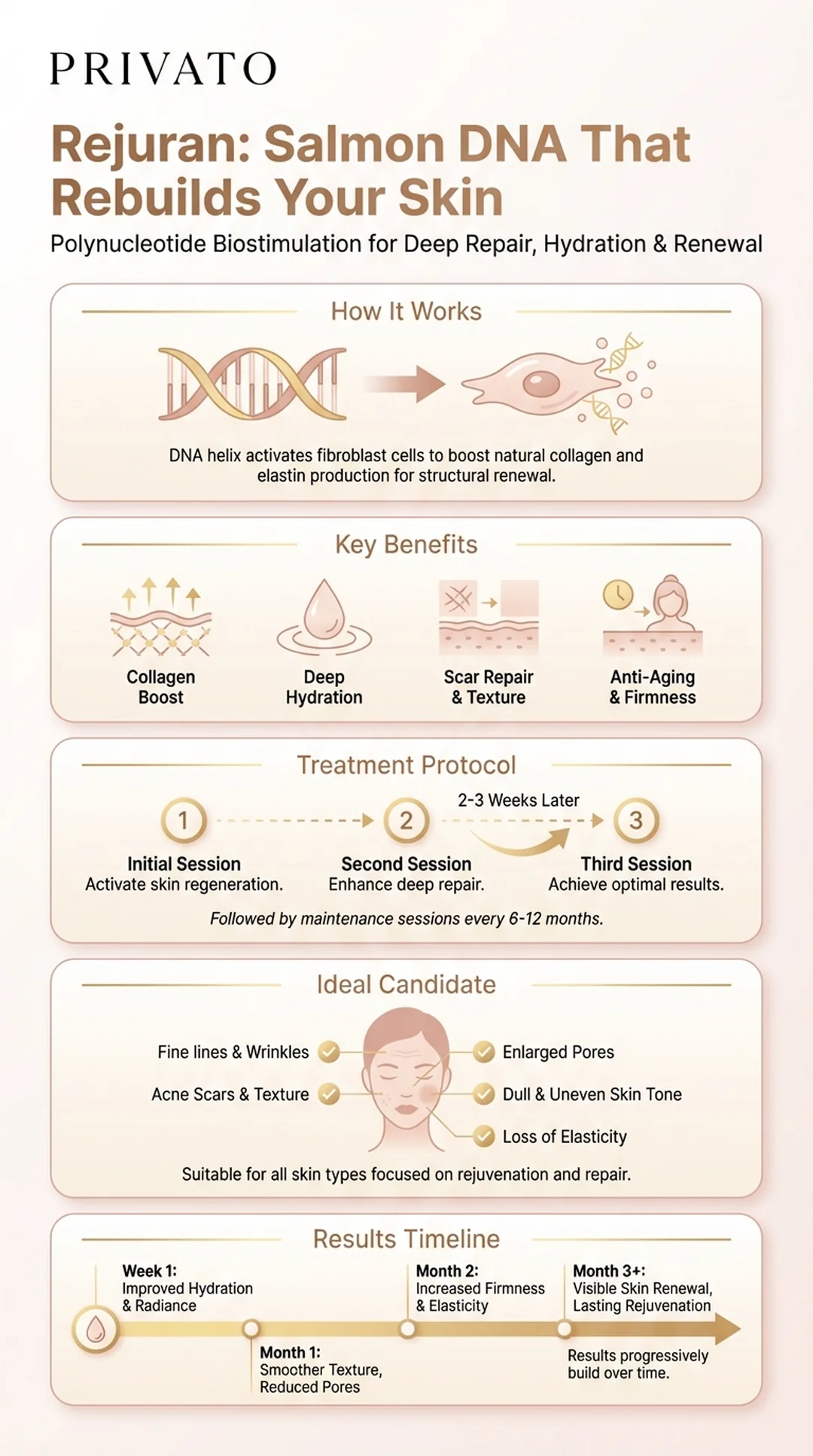
Rejuran is an intradermal skin booster composed of polynucleotides (PN) derived from salmon DNA that functions as a biostimulator for skin healing and repair. Unlike traditional fillers that provide immediate volume, Rejuran rejuvenates the skin through several biological mechanisms:
- A2A Receptor Activation: Once injected, the PN fragments are degraded, releasing nucleotides that bind to adenosine A2A receptors on fibroblasts.
- Fibroblast Stimulation: This binding, supported by a “salvage pathway” for DNA synthesis, triggers fibroblasts to produce essential extracellular matrix (ECM) components, including collagen and elastin.
- Angiogenesis and Repair: The treatment promotes the release of vascular endothelial growth factor (VEGF), which supports blood vessel formation and dermal tissue repair.
- Deep Hydration: Because DNA polymers are naturally hydrophilic, they bind water to the skin’s internal structure, improving viscoelasticity and reducing transepidermal water loss.
The Science of Polynucleotides: How Salmon DNA Repairs Skin
Polynucleotides (PN) repair skin by activating adenosine A2A receptors and supporting the “salvage pathway” to stimulate fibroblast activity. These DNA-origin polymers, typically extracted from salmon trout or chum salmon sperm cells, are degraded in the skin to release nucleotides. This process triggers several regenerative mechanisms:
- Fibroblast Stimulation: Binding to A2A receptors signals fibroblasts to increase the production of collagen (Types I and III), elastin, and other extracellular matrix (ECM) proteins.
- Angiogenesis: The signaling pathways support the release of Vascular Endothelial Growth Factor (VEGF), which promotes the formation of new blood vessels for better tissue repair.
- Hydration: Because DNA polymers are hydrophilic, they bind water to the skin’s phosphate groups, improving dermal water retention and viscoelasticity.
- Anti-inflammation: The treatment is associated with a reduction in pro-inflammatory cytokines, creating a more favorable environment for skin healing.
Larger PN chains (≥1500 kDa) also act as a structural scaffold within the dermis to support long-term tissue remodeling.
Understanding PN (Polynucleotide) vs. PDRN
PN and PDRN are both DNA-derived polymers used in aesthetic medicine, primarily distinguished by their molecular weight and structural roles. While both are extracted from salmon sperm or germ cells, a 2025 review defines PDRN as DNA fragments smaller than 1500 kDa and PN as larger chains equal to or greater than 1500 kDa. Because of these longer chains, PN is often characterized as having a more “scaffold-like” or structural quality compared to PDRN. Both substances function by activating adenosine A2A receptors and supporting the “salvage pathway” to stimulate fibroblasts, which leads to increased collagen production, hydration, and tissue repair.
The Role of Rejuran in Collagen Production and Elasticity
Rejuran acts as a biostimulator that triggers collagen and elastin production by activating fibroblast receptors and supporting the nucleotide salvage pathway. When polynucleotides (PN) are injected into the skin, they are degraded into smaller fragments that bind to adenosine A2A receptors on fibroblasts. This signaling, combined with the recycling of nucleotides for DNA synthesis, stimulates the cells to produce Type I and Type III collagen, elastin, and other essential proteins for the extracellular matrix (ECM). These biological processes lead to improved dermal repair, increased skin elasticity, and enhanced structural scaffolding within the skin layers
Key Benefits of Rejuran Healer for Different Skin Concerns
Healing Acne Scars and Refining Skin Texture
Rejuran improves acne scars and skin texture by using polynucleotides (PN) to stimulate dermal remodeling and fibroblast activity. This skin-boosting treatment works through the following mechanisms and clinical outcomes:
- Dermal Remodeling: PN fragments bind to adenosine A2A receptors and support the “salvage pathway,” which triggers the production of collagen (types I and III) and elastin to repair the extracellular matrix.
- Clinical Evidence: Research includes a randomized study of 30 patients with moderate-to-severe acne scars where PN was used as a primary remodeling approach, as well as case-based evidence for treating burns and scars.
- Texture and Pores: Beyond scar repair, the treatment is used to refine skin quality; studies using needle-free delivery methods have shown improvements in pore size and wrinkle reduction with less discomfort than traditional injections.
- Hydration Support: The hydrophilic nature of DNA polymers increases dermal water retention, which contributes to a smoother, firmer skin surface.
Visible changes in texture and hydration are often noted within weeks, while significant improvements in acne scarring have been reported as early as one month into treatment.
Deep Hydration and Pore Size Reduction
Rejuran improves skin hydration and pore size by using polynucleotides (PN) to stimulate dermal repair and bind water molecules. As a hydrophilic DNA-origin polymer, PN increases dermal water retention and reduces transepidermal water loss, leading to improved skin quality and viscoelasticity. Clinical observations and split-face studies indicate that these “biorepair” mechanisms result in visible reductions in pore size and wrinkles, particularly when delivered via precise intradermal injection or needle-free jet technology. (Scientific Reports, 2025)
Anti-Aging Effects for Fine Lines and Wrinkles
Rejuran improves fine lines and wrinkles by using polynucleotides (PN) to stimulate fibroblast activity and remodel the extracellular matrix. Unlike Botox, which freezes muscles to smooth dynamic lines, Rejuran provides the skin with DNA-derived building blocks that promote the production of collagen and elastin.
Key aspects of its anti-aging effects include:
- Biological Repair: PN fragments bind to A2A receptors, triggering a “salvage pathway” that supports tissue regeneration and reduces pro-inflammatory cytokines.
- Hydration and Elasticity: The hydrophilic nature of DNA polymers increases dermal water retention, which improves skin viscoelasticity and firmness.
- Clinical Outcomes: Observational data shows that after three sessions, clinicians reported visible facial improvements in 100% of cases, with over half rated as “marked” or “excellent.”
- Texture Refinement: Studies indicate significant improvements in pore size and wrinkle depth, particularly when delivered via automated injectors or needle-free jet technology to ensure consistent depth.
Comparing Rejuran with Other Skin Boosters
Rejuran vs. Botox: Which is better for your skin?
The choice between Rejuran and Botox depends on your specific skin goals, as Rejuran is a “skin booster” designed for cellular repair and hydration, while Botox is a neuromuscular blocker used to temporarily smooth dynamic wrinkles.
Because they function through different biological mechanisms, they are often used for different indications:
- Mechanism of Action: Rejuran uses polynucleotides (PN) derived from salmon DNA to stimulate fibroblasts, promote collagen production, and improve skin elasticity. Botox (Botulinum toxin type A) works by blocking acetylcholine release, which relaxes the muscles responsible for expression lines.
- Primary Benefits: Rejuran is better for improving overall skin quality, treating acne scars, and increasing hydration. Botox is the standard for reducing active wrinkles in the forehead, glabella, and around the eyes (crow’s feet).
- Longevity: Botox effects typically last 3–4 months. Rejuran protocols often require an initial series of 3 sessions spaced 2–3 weeks apart, with results evaluated approximately 3 months after the final treatment.
- Target Area: Rejuran is injected intradermally to treat the skin’s “scaffold,” whereas Botox is injected into the muscle to stop movement.
Rejuran vs. Hyaluronic Acid Fillers
Rejuran and hyaluronic acid (HA) fillers differ fundamentally in their biological function, with Rejuran acting as a regenerative “biorepair” agent while HA fillers primarily provide immediate volume and hydration.
The following table and details compare these two injectable treatments:
| Feature | Rejuran (Polynucleotides) | HA Fillers |
|---|---|---|
| Primary Goal | Cellular repair and skin quality | Volumization and contouring |
| Mechanism | DNA fragments (PN) trigger fibroblast receptors | Cross-linked HA physically fills space |
| Key Benefit | Improved texture, scars, and elasticity | Restored volume and deep wrinkle filling |
| Durability | Cumulative; assessed at ~3 months | Immediate; lasts 6–18+ months |
- Biological Action: Rejuran uses salmon-derived DNA polymers to activate adenosine A2A receptors, which stimulates the production of collagen and elastin. In contrast, HA fillers are typically microbially fermented and cross-linked to resist degradation, acting as a structural scaffold.
- Hybrid Options: Some newer “complex” fillers combine both PN and HA to provide the immediate volumizing effects of HA with the long-term tissue regeneration benefits of polynucleotides.
- Clinical Positioning: While HA fillers are the standard for addressing hollow areas or deep folds, Rejuran is positioned as a “skin booster” for overall dermal health and healing.
The Rejuran Injection Procedure: Step-by-Step Guide
How many sessions of Rejuran are needed for best results?
For best results, a typical treatment protocol consists of three intradermal sessions spaced approximately two to three weeks apart. Clinical observations of polynucleotide (PN) treatments indicate that outcomes are generally evaluated three months after the final injection, with high patient satisfaction reported at this stage. While some clinics may recommend up to four sessions depending on individual skin needs, the three-session template is the standard for establishing visible improvements in skin quality and texture
Injection Techniques: Manual vs. Injector Gun
Injector guns provide standardized depth and consistency, whereas manual injections allow for clinician-driven precision but may result in more variability.
The choice between these two techniques involves several practical considerations:
- Depth Control: Automated injectors can be set to specific depths, such as a mean of 0.55 mm, to account for regional variations in skin thickness.
- Consistency: Devices can deliver the product across hundreds of points (e.g., 317 points) with a controlled volume per injection, which is difficult to replicate manually.
- Pain Management: While manual injections are the traditional method, needle-free jet delivery or automated systems are often used to reduce patient discomfort during the intradermal papule process.
- Accuracy: Some advanced protocols use 33-MHz ultrasound mapping to guide the injector gun, ensuring the polynucleotides are placed exactly where needed for optimal dermal repair.
Is Rejuran right for you? Identifying the ideal candidate
The ideal candidate for Rejuran is an adult seeking to improve skin quality, hydration, and texture rather than immediate volume or muscle relaxation. This treatment is particularly suited for individuals with the following profiles:
- Skin Quality Concerns: Those looking to address fine lines, enlarged pores, or mild-to-moderate acne scarring through dermal remodeling.
- Age and Skin Type: Adults across a wide age range (approximately 28–74) with Fitzpatrick skin types I–IV have shown positive outcomes in clinical observations.
- Specific Treatment Areas: Individuals targeting the face, neck, or décolleté for bio-revitalization.
- Procedural Preferences: Patients who prefer “biorepair” mechanisms—using salmon-derived polynucleotides to stimulate collagen and elastin—over traditional hyaluronic acid fillers or Botox.
Candidates should avoid this treatment if they are pregnant or lactating, have a known allergy to polynucleotide sodium, or are currently using anticoagulants or immunosuppressants.
Safety, Side Effects, and Post-Treatment Care
Common Side Effects: Bumps, Redness, and Swelling
Transient swelling, erythema (redness), and pain are the most frequently reported side effects of Rejuran treatment. These reactions occur because the polynucleotides are injected intradermally, often creating small temporary papules or “bumps” at the injection sites. Other common side effects include:
- Bruising: Small bruises may appear depending on the injection technique used.
- Heat or Itching: Some patients experience a sensation of warmth or mild irritation immediately following the procedure.
- Procedural Discomfort: Pain is a known barrier during manual needle injections, though using automated injector devices or needle-free delivery can help reduce this.
In clinical observations of polynucleotide treatments, no serious or unexpected adverse events were reported, and most side effects resolve within a few days. (PN HPT real-world dataset, 2025)
How long does Rejuran last and how to maintain results?
Rejuran results are typically evaluated three months after the final session, with effects generally lasting several months depending on the individual. While long-term durability beyond this window is less clearly quantified in peer-reviewed data, the treatment is often compared to Botox, which has a similar maintenance cadence of approximately 3 to 4 months.
To maintain and optimize results, follow these standard protocols:
- Initial Series: Complete a full starting cycle, typically consisting of 3 to 4 sessions spaced 2 to 4 weeks apart.
- Maintenance Sessions: Schedule follow-up treatments every 3 to 6 months to sustain skin quality and hydration.
- Aftercare: Follow clinic-specific instructions, such as using only gentle cleansing (water or saline) for the first 24 hours and avoiding makeup for several hours post-injection.
- Technique Selection: Consider automated injector devices or needle-free jet delivery if pain management is a concern, as these can improve procedural consistency and comfort.
Contraindications: Who should avoid Rejuran injections?
Individuals who are pregnant, lactating, or have a known hypersensitivity to polynucleotide sodium should avoid Rejuran injections. Additional contraindications and cautions include:
- Medical Conditions: Avoid treatment if you have active skin inflammation or infections in the target area.
- Medication Interactions: Use caution or avoid the procedure if you are taking anticoagulants, antiplatelets, NSAIDs, or immunosuppressants.
- Procedural Safety: Injections must never be administered intravascularly.
Rejuran Treatment Cost and Choosing a Clinic in Thailand
In Thailand, Rejuran treatment typically costs between 9,000 THB and 13,200 THB per session, with multi-syringe packages priced around 29,000 THB. Prices vary based on the specific clinic, the volume of product used (often 2 cc per session), and whether the price includes additional services like numbing or aftercare.
When choosing a clinic in Thailand, consider the following factors:
- Provider Credentials: Prioritize licensed medical injectors who can verify a sterile supply chain and use single-use syringes.
- Technology and Technique: Some clinics use automated injector devices or ultrasound mapping to ensure a consistent injection depth (typically around 0.55 mm) and reduce procedural variability.
- Protocol Alignment: Effective results often require a series of 3–4 sessions spaced 3–4 weeks apart; ensure the clinic’s recommended plan matches these established benchmarks.
- Safety Standards: Verify that the clinic follows contraindication protocols, such as avoiding treatment during pregnancy or for patients on anticoagulants.
FAQs About Rejuran Treatment
Is Rejuran actually made from salmon sperm?
Yes, Rejuran is derived from salmon DNA fragments typically extracted from salmon sperm or germ cells. While the treatment is made from these biological sources, the final product consists of highly purified polynucleotides (PN) or polydeoxyribonucleotides (PDRN) rather than whole cells. These DNA-origin polymers are used for their skin-healing and biostimulating properties, specifically by activating adenosine receptors to support tissue repair and hydration.
Is the Rejuran injection process painful?
Pain is a known barrier during Rejuran injections, though discomfort levels vary based on the delivery method. While traditional intradermal papule injections using needles are associated with pain, several techniques and technologies are used to manage this:
- Needle-free delivery: Research indicates that using needle-free jet delivery significantly reduces patient discomfort compared to standard needle injections.
- Automated injectors: Devices like the Rejumate injector can standardize injection depth (averaging 0.55 mm), which may help improve procedural consistency and manage sensations.
- Common sensations: Patients frequently report transient pain, heat, itching, and stinging during or immediately after the procedure.
- Clinical management: Many clinics utilize numbing agents or specific aftercare protocols to mitigate sensitivity during the session. (A randomized split-face study concluded needle-free jet delivery of PN improved pore/wrinkle outcomes while reducing discomfort versus needle injection, 2025)
How many days does it take to see results after Rejuran?
Visible results from Rejuran typically begin to appear within weeks, with some studies showing changes in skin texture or acne scars as early as one month. While initial hydration and texture improvements may be noticed shortly after the first session, clinical outcomes for skin quality are often formally evaluated three months after the final treatment in a standard three-session protocol.
Can I wash my face immediately after a Rejuran treatment?
No, you should generally wait at least 24 hours before washing your face with anything other than gentle cleansing agents like water or saline. While specific aftercare instructions vary by clinic, many protocols advise avoiding makeup for several hours and sticking to minimal, non-irritating cleansing for the first day following the procedure.