
Meso Fat Injection: How It Works, Safety, and Results
A meso fat injection is a subcutaneous treatment that uses cytolytic agents like deoxycholic acid to physically destroy fat cell membranes for localized contouring, typically requiring up to six sessions.
What is a meso fat injection and how does it dissolve stubborn fat?
Meso fat injections are subcutaneous treatments that target localized fat deposits by physically destroying fat cell membranes. While the term is often used as a marketing umbrella for various “fat-dissolving” cocktails, the most clinically established agent is deoxycholic acid. This substance acts as a cytolytic agent, meaning it disrupts the structural integrity of the adipocyte (fat cell) membrane upon contact. Once the cells are destroyed, the body’s natural inflammatory response triggers macrophages to clear the resulting cellular debris and lipids over several weeks, leading to a visible reduction in fat volume
How the Mesotherapy Process Works for Targeted Fat Reduction
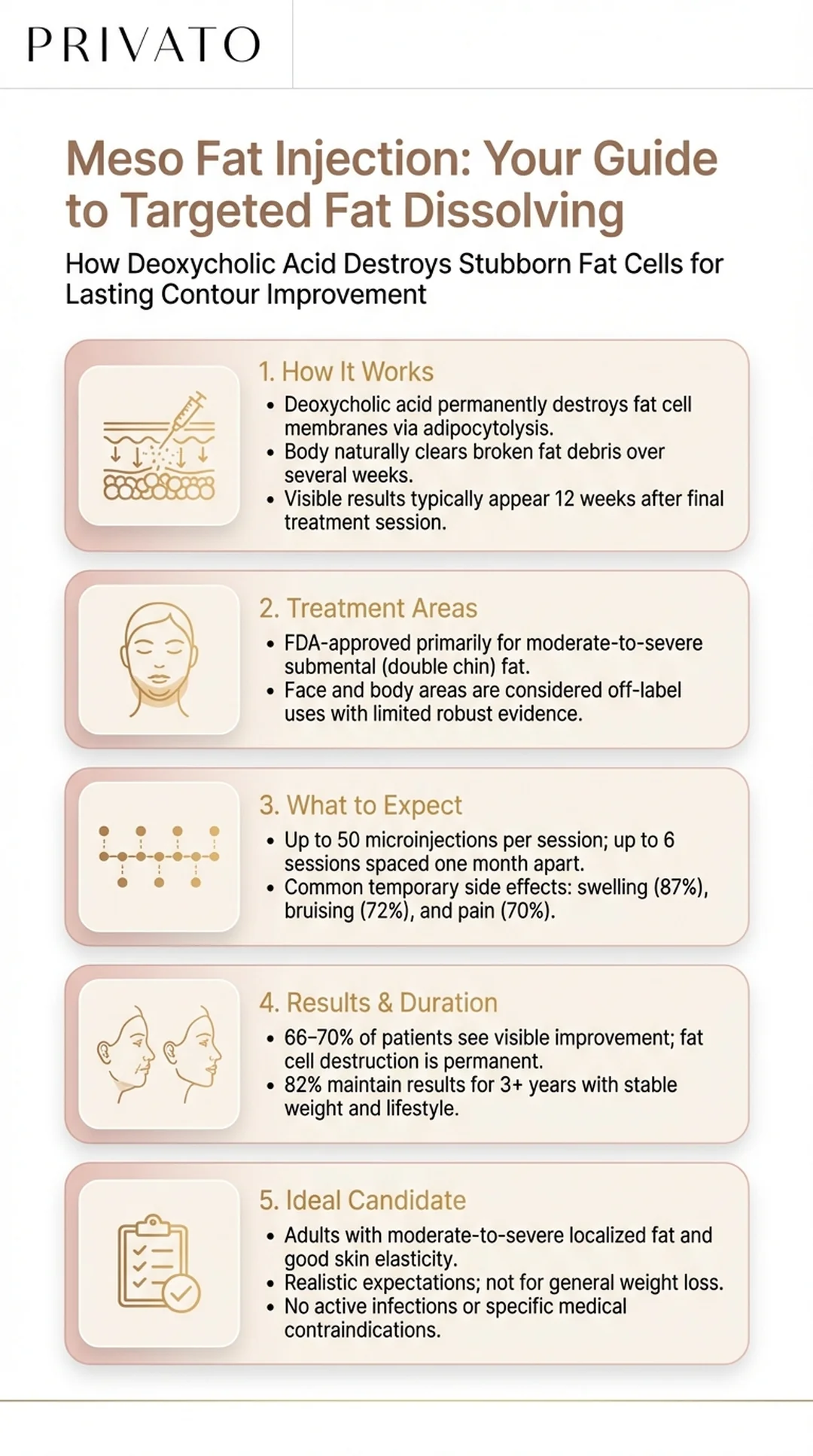
Mesotherapy for fat reduction works by injecting cytolytic agents, most commonly deoxycholic acid, into subcutaneous fat to physically disrupt and destroy fat-cell membranes. This process, known as adipocytolysis, triggers a localized inflammatory response where the body’s immune cells, such as macrophages, recruit to clear the resulting cellular debris and released lipids.
The standard procedure involves several specific technical steps:
- Injection Depth: Agents must be placed precisely into the subcutaneous fat layer; injecting too shallowly into the dermis can cause skin ulceration or necrosis.
- Dosing and Spacing: For submental (under-chin) fat, clinicians typically inject 0.2 mL per site, spaced 1 cm apart, using an area-adjusted grid.
- Treatment Cycle: Patients may receive up to 50 injections per session, with a maximum of six sessions spaced at least one month apart.
- Tissue Response: Following the destruction of fat cells, fibroblast activation and collagen deposition may occur, which can contribute to tightening the treated area’s contour.
Visible results are not immediate, as the body requires time to clear the destroyed cells; outcomes are typically assessed 12 weeks after the final treatment session
The science behind fat-dissolving active ingredients
The primary science behind fat-dissolving injections involves adipocytolysis, a cytolytic process where active agents physically disrupt and destroy fat-cell membranes. Unlike metabolic “fat burning,” these injections cause permanent cell destruction in the subcutaneous fat layer.
The most clinically established agent is deoxycholic acid, a bile acid that acts as a detergent to lyse adipocytes. The biological response to this destruction follows a specific sequence:
- Cell Lysis: The agent disrupts the phospholipid bilayer of the fat cell membrane.
- Inflammatory Response: The body triggers a localized tissue response, including neutrophilic infiltration.
- Debris Clearance: Macrophages are recruited to the site to clear the released lipids and cellular debris.
- Tissue Remodeling: Fibroblast activation and subsequent collagen deposition may lead to secondary contour tightening in the treated area.
While deoxycholic acid is the only FDA-approved injectable for submental fat, other formulations like phosphatidylcholine are sometimes used, though they may work through different mechanisms such as inducing apoptosis or lipolysis
Common treatment areas: Face, double chin, and body
Meso fat injections are primarily indicated for the reduction of moderate-to-severe submental fat, commonly known as a double chin. While the term “meso fat” is often used as a marketing umbrella for various localized fat reduction treatments, the clinical evidence and regulatory approvals are most established for the following areas:
- Double Chin (Submental Fat): This is the only area with strong clinical evidence and FDA approval for deoxycholic acid injections, which work by physically disrupting fat-cell membranes to improve the contour of the neck.
- Face (Jowls): Some expert reviews discuss application in the jowl area, though they caution that surgery is often preferable for jowling caused by skin sagging rather than fat, and injections are contraindicated if the jowling is due to tissue atrophy.
- Body (Belly and Flanks): Use in larger body areas like the abdomen or flanks is considered “off-label” and lacks robust clinical trials; current evidence for these areas is limited to small case series and preliminary reports.
What to expect during your first injection session
During your first injection session, you should expect a series of subcutaneous microinjections into the targeted fat layer, typically spaced 1 cm apart. A standard submental (under-chin) treatment involves the following:
- Procedure Details: A medical professional uses a small 30G needle to inject approximately 0.2 mL of the agent per site, with up to 50 injections (10 mL total) possible in one session.
- Immediate Sensations: You may feel local pain, and the provider may apply pressure to injection sites to minimize bleeding.
- Common Side Effects: High percentages of patients experience immediate or short-term swelling (87%), bruising (72%), pain (70%), and numbness (66%).
- Safety Precautions: The injector must avoid the area above the mandible and the platysma muscle to prevent nerve injury or swallowing difficulties.
Is Meso Fat Injection Effective for Weight Loss?
No, meso fat injections are not effective for weight loss and are intended only for localized contouring. These injections, such as deoxycholic acid, work by destroying fat cells in specific, small areas like under the chin rather than reducing overall body weight. Clinical data shows that while they can reduce the volume of targeted fat pockets by approximately 10% or more, they do not serve as a treatment for obesity or a substitute for weight loss methods. (Meso Fat Injections: Mechanisms, Effectiveness, Candidate Selection, Safety, Aftercare, and FAQs, Mayo Clinic, 2025)
Meso fat vs. Liposuction: Understanding the differences
Meso fat injections and liposuction differ primarily in their invasiveness, fat removal capacity, and recovery time. While both procedures target localized fat, they utilize distinct methods and offer different clinical outcomes:
- Mechanism: Meso fat injections (such as deoxycholic acid) use a cytolytic chemical to physically disrupt and destroy fat cell membranes, which the body then clears over several weeks. Liposuction is a surgical procedure where a clinician uses a cannula to suction out fat volumes through small incisions.
- Volume and Speed: Liposuction removes larger volumes of fat in a single session with faster visible results. Meso fat injections are intended for modest contouring of small areas, such as under the chin, and typically require up to six sessions spaced at least one month apart.
- Recovery and Risks: Liposuction involves higher surgical risks and longer downtime. Meso fat injections are non-surgical but frequently cause significant temporary swelling, bruising, and pain, with a 55.1% positive patient review rate compared to 83.4% for submental liposuction.
- Cost: Injections may have a lower upfront cost per session, but the cumulative expense of multiple treatments can be significant; for example, in Thailand, submental liposuction may start around 49,000 THB, while individual injection sessions are priced much lower. (American Society of Plastic Surgeons, 2025)
How many sessions are required to see visible results?
Patients typically require up to six sessions spaced at least one month apart to achieve visible results. While some clinical improvements may be noticed earlier, official assessments of effectiveness are generally conducted 12 weeks after the final treatment session to allow for the resolution of initial swelling and the completion of the fat clearance process
Meso fat injection before and after: Real-world expectations
Real-world expectations for meso fat injections involve a gradual reduction in localized fat over several months, typically requiring multiple treatment sessions. While immediate post-injection effects include significant swelling, bruising, and numbness, visible contour improvements are generally assessed 12 weeks after the final session.
- Treatment Course: Most patients require up to 6 sessions spaced at least one month apart to achieve desired results.
- Clinical Outcomes: In major trials, approximately 66% to 70% of patients saw a visible improvement of at least one grade in chin fat fullness.
- Durability: Results are long-lasting because the injections destroy fat cells (adipocytolysis) rather than just shrinking them; follow-up data shows over 82% of patients maintain their results for at least three years, provided their weight remains stable.
- Common Side Effects: Expect local reactions such as edema (87%), bruising (72%), and pain (70%) shortly after the procedure.
- Comparison to Surgery: While less invasive than liposuction, injections provide more modest volume reduction and require more patience to see the final “after” effect.
Who is the Ideal Candidate for Fat Dissolving Injections?
The ideal candidate for fat-dissolving injections is an adult with moderate-to-severe submental (under-chin) fat who possesses good skin elasticity and pinchable pre-platysmal fat.
Beyond these primary physical characteristics, suitable candidates should meet the following criteria:
- Specific Treatment Area: The only FDA-approved use for deoxycholic acid is the submental area; candidates seeking treatment for “belly fat” or large body areas are generally better suited for liposuction.
- Medical History: Candidates must not have an active infection at the injection site and should have no history of dysphagia (difficulty swallowing), as swelling can exacerbate this condition.
- Realistic Expectations: Individuals should seek localized contour improvement rather than significant weight loss, as the procedure destroys specific fat cells rather than burning fat metabolically.
- Anatomical Suitability: Evaluation must exclude other causes of fullness, such as thyromegaly or cervical lymphadenopathy, and ensure the fullness is not caused by excessive skin laxity or prominent platysmal bands. (Meso Fat Injections: Mechanisms, Effectiveness, Candidate Selection, Safety, Aftercare, and FAQs)
Targeting localized fat vs. overall body weight
Meso fat injections are designed for localized contouring of subcutaneous fat rather than overall body-weight loss. These injections, such as deoxycholic acid, work through cytolysis to physically destroy fat cell membranes in specific areas like the chin. Because the treatment targets small, “pinchable” pockets of fat to improve local appearance, it is not a substitute for weight loss methods or a treatment for obesity.
When to consult a specialist for professional fat reduction
You should consult a specialist for professional fat reduction if you are an adult with moderate-to-severe localized fat, such as under the chin, and have good skin elasticity. A professional evaluation is necessary to exclude other causes of fullness, such as thyromegaly or lymphadenopathy, and to assess whether your anatomy is suitable for injections or if surgical options like liposuction are preferable. Consultation is also critical for individuals with a history of swallowing difficulties (dysphagia), bleeding disorders, or prior neck surgeries, as these factors significantly impact the safety and placement of treatments
Safety Considerations and Potential Side Effects
Common side effects: Swelling, bruising, and tenderness
The most common side effects of meso fat injections are swelling, bruising, and pain. According to clinical trial data for deoxycholic acid, these local reactions occur frequently, with swelling affecting 87% of patients, bruising or hematoma in 72%, and pain in 70%. Other common side effects include numbness (66%), redness (27%), and areas of hardness or induration (23%)
Is meso fat injection safe for everyone?
No, meso fat injections are not safe for everyone and are subject to specific contraindications and narrow candidate profiles. While deoxycholic acid is approved for adults with moderate-to-severe submental (under-chin) fat, it is strictly contraindicated for individuals with an active infection at the injection site. Safety and effectiveness have not been established for pediatric patients, and the treatment is not recommended for those with a history of dysphagia (difficulty swallowing), as post-injection swelling can exacerbate this condition. Additionally, patients with excessive skin laxity, prominent platysmal bands, or prior surgical scarring in the treatment area may not be suitable candidates. Because of the risk of bleeding and bruising, individuals with coagulation abnormalities or those taking antiplatelet and anticoagulant therapies must exercise extreme caution. Regulators also warn against using unapproved “fat-dissolving” injections or receiving treatment from unlicensed providers, as these increase the risk of serious complications such as infection, permanent scarring, and skin necrosis
Contraindications: Who should avoid mesotherapy?
Individuals with an active infection at the intended injection site must avoid these treatments. Additional contraindications and precautions include:
- Current or prior dysphagia: Patients with a history of difficulty swallowing should avoid the procedure as swelling can exacerbate the condition.
- Bleeding disorders: Those with coagulation abnormalities or those taking antiplatelet/anticoagulant therapy face a high risk of bruising and hematoma.
- Specific anatomical concerns: Individuals with excessive skin laxity, prominent platysmal bands, or prior surgical scarring in the treatment area may not be suitable candidates.
- Pregnancy and breastfeeding: Due to limited safety data, these individuals are advised to consult a doctor and exercise extreme caution.
- Pediatric patients: Safety and effectiveness have not been established for children. (Kybella, FDA Label, 2025)
Aftercare and Maintaining Your Results
Post-treatment tips to maximize fat breakdown
There is no robust clinical evidence that specific aftercare activities, such as increased hydration, directly maximize the biological breakdown of fat cells. While “fat flushing” through extra fluids is a common claim in clinic marketing, pivotal trials do not demonstrate a link between fluid intake and increased adipocyte clearance. To manage the treatment area and support the recovery process, providers often recommend the following:
- Apply pressure: Immediately following injections, clinicians may apply pressure to the sites to minimize bleeding and hematoma formation.
- Manage inflammation: Expect swelling, bruising, and “hardness” for several days; some protocols suggest using cooling or compression bandages for 2–3 days to reduce these effects.
- Support lymphatic drainage: Some practitioners suggest adjunct lymphatic drainage twice weekly for 2–3 weeks to help reduce post-injection swelling.
- Maintain weight stability: While destroyed fat cells do not regrow, remaining cells can enlarge with weight gain, so maintaining a stable weight is essential to preserve the contoured results.
- Limit strenuous activity: It is common practice to avoid intense exercise until initial swelling and tenderness subside.
How long do the results of meso fat injections last?
Results from meso fat injections can last for multiple years, provided the patient maintains a stable body weight. Long-term durability data for deoxycholic acid (the primary agent in these injections) shows that 82.4% of patients maintained their improvement three years after completing treatment. While the injections permanently destroy targeted fat cells, the remaining cells in the area can still enlarge if the patient gains weight, which may alter the visible contour over time
FAQs About Meso Fat Injections
How much does fat dissolving injections cost in Thailand?
Fat dissolving injection costs in Thailand typically range from 4,000 THB to 30,000 THB depending on the volume of the product used.
Specific pricing often follows a “per cc” or “per area” structure:
- Volume-based pricing: Approximately 4,000 THB for 4 cc, 8,000 THB for 8 cc, and up to 30,000 THB for 32 cc.
- Area-based pricing: Starting prices around 10,000 THB per treated area.
- Comparison: For larger areas, surgical options like double chin liposuction may start at approximately 49,000 THB.
Total costs are influenced by the number of sessions required (often 3–6), the specific product formulation used, and any promotional packages offered by the clinic.
How long does meso fat injection last?
Meso fat injections can provide results that last for multiple years, provided the patient maintains a stable body weight. Long-term durability data for deoxycholic acid (the primary agent in these injections) shows that 82.4% of patients maintained their clinical improvement three years after completing their treatment sessions. While the injections permanently destroy targeted fat cells, the remaining fat cells in the area can still enlarge if the patient gains weight, which may alter the visible contour over time (Long-term safety and efficacy of ATX-101 for the treatment of submental fat, Journal of the American Academy of Dermatology, 2024)
Is meso fat injection effective for belly fat?
Evidence for the effectiveness of meso fat injections on belly fat remains sparse and is not currently supported by major regulatory approvals. While deoxycholic acid is well-established for reducing fat under the chin, its use for larger body areas like the abdomen is considered “off-label” and lacks robust clinical trial data to confirm safety or consistent results. Preliminary studies on non-submental body contouring have shown only subtle improvements in small case series, and experts emphasize that large-volume fat collections are generally better suited for liposuction or device-based treatments
What is the difference between meso fat and mesotherapy?
The primary difference is that meso fat injections target the subcutaneous fat layer to destroy fat cells, while mesotherapy involves microinjections into the superficial dermis. Mesotherapy typically uses a technique of injecting small doses (0.1–0.2 mL) at a depth of approximately 2 mm with 1–3 cm spacing to allow for local deposit and slow diffusion. In contrast, meso fat—often referred to as injection lipolysis or adipocytolysis—requires accurate depth placement into the fat layer to physically disrupt cell membranes, and its safety depends on avoiding the skin and muscle layers (Meso Fat Injections: Mechanisms, Effectiveness, Candidate Selection, Safety, Aftercare, and FAQs, 2025)