
Laser Tattoo Removal in Bangkok | Privato Clinic
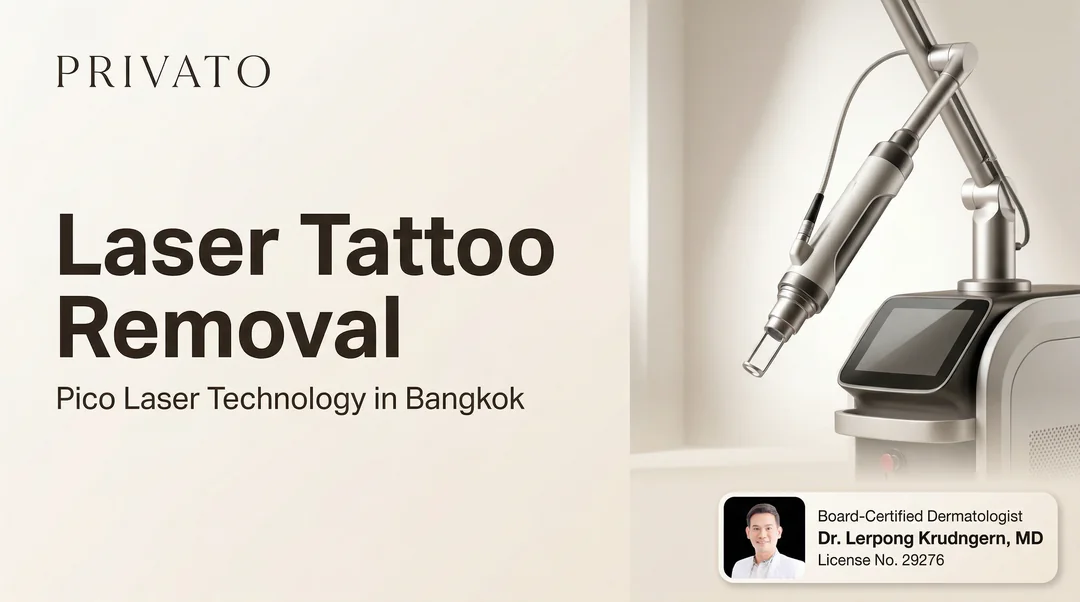
Laser tattoo removal bangkok typically costs between 3,000 and 7,000 THB per session for small areas, utilizing advanced Pico laser technology to fragment ink over three to ten required treatments.
How much does laser tattoo removal cost in Bangkok and which clinic is best?
Laser tattoo removal in Bangkok typically costs between 3,000 THB and 7,000 THB per session for small areas, while large-area treatments at major hospitals can range from 20,000 THB to 30,000 THB. Total costs scale linearly with the number of sessions required, which often ranges from 3 to 10 visits depending on the tattoo’s size, ink color, and depth.
The “best” clinic is defined by medical oversight and the availability of appropriate technology for your specific tattoo:
- Bangkok Hospital: Offers structured pricing by size, such as 5,000 THB for areas up to 3×3 cm and 10,000 THB for 10×10 cm to 20×20 cm, including anesthesia.
- Bumrungrad International Hospital: Provides comprehensive clinical evaluations considering skin type and tattoo age, with a single pricing system for all nationalities.
- Yanhee Hospital: Features itemized pricing for specific platforms like PicoWay, with rates such as 3,300 THB for a 1×1 cm area.
- Specialized Clinics: Facilities like Mingkwan Clinic offer competitive per-session rates, such as 3,000 THB for eyebrow removal and 6,000 THB for 10×10 cm areas.
When choosing a provider, prioritize board-certified dermatology oversight and verify that the laser wavelengths (e.g., 1064 nm for black ink, 532 nm for red) match your tattoo’s colors to minimize the risk of scarring or permanent pigment changes
What is Pico Laser Tattoo Removal and How Does It Work?
Pico laser tattoo removal is a medical procedure that uses ultra-short picosecond (ps) pulses of light to break down tattoo ink into tiny particles. It works primarily through a photoacoustic or photomechanical mechanism, where the rapid delivery of energy creates a shockwave that fragments the ink without excessive heat.
Key aspects of how the process works include:
- Fragmentation: The laser targets specific ink colors using different wavelengths; for example, 1064 nm is typically used for black or dark inks, while 532 nm targets red, orange, and yellow.
- Immune Clearance: Once the laser shatters the ink into microscopic fragments, the body’s immune system—specifically cells called macrophages—clears the debris over several weeks.
- Clinical Endpoint: During treatment, a temporary white “frosting” effect (gas bubbles) usually appears on the skin, indicating the laser has successfully interacted with the pigment.
- Multiple Sessions: Because ink is layered at different depths, most tattoos require between 3 to 10 sessions spaced 6 to 8 weeks apart to allow for proper healing and pigment clearance.
The Difference Between Picoway, Picosecond, and Revlite Lasers
The primary difference is that picosecond is a category of laser technology, while PicoWay and RevLite are specific brand-name platforms that utilize different pulse durations and mechanisms to remove ink.
- Picosecond Lasers: This is a broad class of lasers that deliver energy in ultra-short bursts (trillionths of a second). They primarily use a photoacoustic or photomechanical effect to shatter ink particles into tiny fragments that the immune system can clear more easily than older technologies.
- PicoWay: This is a specific brand of picosecond laser manufactured by Candela Medical. It operates with pulse durations typically between 300 and 450 picoseconds, which is designed to maximize the photoacoustic effect for various ink colors and particle sizes.
- RevLite (RevLite SI): This is a brand of Q-switched Nd:YAG laser manufactured by Cynosure. Unlike picosecond lasers, it operates in the nanosecond domain (billionths of a second), using longer pulses (5–20 ns) and a photothermal mechanism to break down pigment.
How Many Sessions Are Required to Fully Remove a Tattoo?
The number of sessions required to fully remove a tattoo typically ranges from 1 to 10 treatments, though complete removal cannot be guaranteed for all cases.
The exact number of sessions depends on several biological and technical factors:
- Tattoo Characteristics: Professional tattoos are often deeper and more uniform, requiring more sessions than amateur or traumatic tattoos. Older tattoos may be easier to remove than newer ones.
- Ink and Color: Black and dark pigments are generally easier to target with a 1064 nm laser, while colors like green, blue, and yellow may require specific wavelengths (755 nm or 532 nm) and more visits.
- Skin Type and Location: Factors such as the patient’s skin type (Fitzpatrick scale), the tattoo’s location on the body, and the presence of pre-existing scarring affect the clearance rate.
- Technology Used: Picosecond lasers have been shown to outperform nanosecond (Q-switched) lasers, achieving higher satisfactory clearance in fewer sessions.
- Biological Timing: Sessions must be spaced 6 to 8 weeks apart to allow the immune system to clear fragmented ink particles and ensure proper skin healing. (American Society of Plastic Surgeons, 2024)
Key Factors Affecting Tattoo Removal Success and Effectiveness
Tattoo Ink Color and Depth: What Can Be Removed?
Laser tattoo removal can target most ink colors and depths, though success depends on matching the specific laser wavelength to the pigment.
The effectiveness of removal is determined by several factors:
- Ink Color and Wavelength:
- Black and dark inks: These are the easiest to treat and are best targeted by the 1064 nm Nd:YAG laser.
- Red, orange, and yellow: These respond best to the 532 nm wavelength.
- Blue, green, and purple: These typically require 694 nm (ruby) or 755 nm (alexandrite) lasers.
- Tattoo Depth and Type: Professional tattoos are usually deeper and more uniform, often requiring more sessions than amateur tattoos, which may have uneven depths.
- Cosmetic Inks: Permanent makeup (like eyebrow tattoos) containing iron oxide can undergo “paradoxical darkening,” turning from red-brown to grey-black when treated with certain lasers.
- Limitations: Complete removal is not always possible, especially for newer inks, pastels, or tattoos with significant layering and pre-existing scarring (StatPearls, 2025)
Tattoo Location and Skin Type Considerations
Tattoo location and skin type are critical factors that determine the laser wavelength used, the number of required sessions, and the overall risk of complications. According to the Kirby-Desai scale, the anatomical location of a tattoo and the patient’s skin type are assigned numeric values to estimate the total number of treatments needed for clearance.
Key considerations include:
- Wavelength Selection: While 1064 nm lasers are generally safe for a broad range of skin types, 532 nm lasers are often restricted to lighter skin (Fitzpatrick types I–III) due to the high risk of melanin competition and pigmentary changes in darker skin.
- Dyspigmentation Risks: Patients with darker skin or those treated with specific wavelengths face a higher risk of hyperpigmentation or hypopigmentation, which may take 6–12 months to fade.
- Session Count: The location of the tattoo affects how efficiently the immune system can clear fragmented ink; areas with higher vascularity typically clear faster than those on the lower extremities.
- Specialized Areas: Cosmetic tattoos, such as eyebrows, require caution because certain red-brown pigments can undergo paradoxical darkening to a grey-black color when exposed to Q-switched lasers (Kirby-Desai, 2009)
Laser Tattoo Removal Price Guide in Bangkok
Average Cost per Session vs. Full Treatment Packages
Bangkok tattoo removal costs typically range from 3,000 to 7,000 THB per session for small areas, while full treatment costs depend on the total number of sessions required.
Pricing structures in Bangkok clinics and hospitals generally follow these patterns:
- Per-Session Pricing by Size:
- Small areas (up to 3×3 cm): Approximately 3,000 to 5,000 THB.
- Medium areas (up to 10×10 cm): Approximately 6,000 to 7,000 THB.
- Large areas (up to 50×50 cm): Can reach 20,000 to 30,000 THB at major hospitals.
- Specialized areas: Eyebrow tattoo removal is often fixed between 3,000 and 6,100 THB.
- Package Considerations:
While some networks like Bangkok Hospital Pattaya offer a package range (3,000–10,000 THB), most providers scale costs linearly based on the number of sessions. Because “complete” removal cannot be guaranteed and typically requires 3 to 10 sessions spaced 6–8 weeks apart, the total investment is determined by the tattoo’s age, ink color, and depth.
Comparing Clinic Prices: From Budget to Premium Wellness Centers
Tattoo removal prices in Bangkok typically range from 3,000 THB to 30,000 THB per session, depending on the tattoo size and the clinic’s tier.
Pricing structures across the city’s medical and wellness landscape include:
- Budget and Specialized Clinics: Smaller clinics like Mingkwan Clinic offer entry-level pricing, such as 3,000 THB for eyebrows, 4,000 THB for a 4×4 cm area, and 6,000 THB for a 10×10 cm area.
- Mid-Range and Specialized Hospitals: Yanhee Hospital provides itemized rates like 3,300 THB for a 1×1 cm area and 16,500 THB for a 10×10 cm area.
- Premium Wellness and General Hospitals: Large networks like Bangkok Hospital use a tiered system based on dimensions:
- Small (≤3×3 cm): 5,000 THB
- Medium (3×3 to 10×10 cm): 7,000 THB
- Large (10×10 to 20×20 cm): 10,000 THB
- Extra Large (up to 50×50 cm): 20,000 to 30,000 THB
These prices often include anesthesia but may exclude initial doctor consultation fees. Total costs scale with the number of sessions required, which typically ranges from 3 to 10 visits
Is Laser Tattoo Removal Right for You?
Laser tattoo removal is an effective option for individuals who can commit to multiple spaced treatments and have realistic expectations regarding fading and potential skin changes. While it is the dominant method for fragmenting ink so the immune system can clear it, “complete” removal cannot be guaranteed for all ink types or colors.
Ideal candidates and key considerations include:
- Commitment to Process: Most tattoos require between 1 and 10 sessions, typically spaced 6 to 8 weeks apart to allow for biological healing and ink clearance.
- Ink and Skin Type: Success depends on the laser wavelength matching the ink color; for example, 1064 nm is often used for dark inks, while 532 nm targets reds and oranges.
- Risk Awareness: While generally safe, potential side effects include temporary redness, swelling, or blistering, and a risk of long-term pigment changes or scarring.
- Professional Oversight: Results depend heavily on the operator; medical societies recommend treatment by board-certified dermatologists to minimize complications. (American Academy of Dermatology, 2023)
Who is an Ideal Candidate for Laser Treatment?
An ideal candidate for laser tattoo removal is someone who can commit to multiple spaced sessions and follow strict sun avoidance and wound care protocols.
Beyond these behavioral requirements, the most suitable candidates possess the following characteristics:
- Realistic Expectations: They understand that complete removal is not always possible and that pigment shifts or fading may occur instead of total clearance.
- Health Awareness: They have discussed their medical history, medications, and any history of raised scars (keloids) with a professional.
- Patience for Biology: They accept that sessions must be repeated every 6–8 weeks to allow the immune system to clear fragmented ink.
- Risk Awareness: They recognize that certain skin types and ink colors (such as pastels or professional-grade inks) carry a higher risk of dyspigmentation or may be more difficult to remove
When to Choose Laser Removal vs. Tattoo Cover-ups
The choice between laser removal and a tattoo cover-up depends on whether the goal is completely clear skin or simply a new design.
- Choose Laser Removal if you require “blank skin” and are prepared for the time and financial commitment of multiple sessions (typically 1–10) spaced 6–8 weeks apart.
- Choose a Cover-up if you want to replace the existing art with a new design; however, a few laser sessions are often recommended first to fade the original ink, which allows for better cover-up geometry and prevents the old tattoo from showing through.
- Considerations: Professional societies note that complete removal is not always possible, and some scarring or pigment variation may occur regardless of the method chosen
Professional Tattoo Removal Services in Bangkok Clinics
What to Expect During Your First Consultation
During your first consultation, you should expect a comprehensive medical and tattoo assessment to determine your suitability for treatment and establish a realistic clearance plan.
The process typically includes the following steps:
- Tattoo Evaluation: The clinician will document the age, ink colors, and location of the tattoo, as well as the presence of any pre-existing scarring or tissue changes.
- Medical History Review: You will discuss your general health, current medications, and any history of raised scars or keloids.
- Risk and Outcome Discussion: The provider will explain realistic clearance endpoints, the expected number of sessions (often 1–10), and potential risks such as pigment shifts or scarring.
- Visual Evidence: You may be shown provider-specific before-and-after photos to help set expectations for the results.
- Test Spotting: In some cases, especially for cosmetic or red-brown pigments, a test spot may be performed to check for paradoxical darkening before proceeding with full treatment
Advanced Techniques for Eyebrow and Permanent Makeup Removal
Removing eyebrow and permanent makeup (PMU) requires specialized laser protocols to manage the high risk of paradoxical darkening. Because many cosmetic inks contain iron oxide or similar compounds, exposure to Q-switched or picosecond lasers can cause red-brown pigments to instantly turn grey or black.
To mitigate these risks and ensure safe removal, practitioners follow these advanced clinical guidelines:
- Test-Spot Protocols: Clinical guidance recommends performing staged test spots to observe how the specific ink reacts before treating the entire eyebrow or lip area.
- Wavelength Selection: Operators must choose wavelengths based on the shifted pigment color; for example, 1064 nm is often used for the dark pigments that remain after paradoxical darkening occurs.
- Safety and Aftercare: Because the skin on the face is delicate, using the lowest effective fluence is emphasized to prevent pinpoint bleeding, tissue spatter, or permanent scarring.
- Expectation Management: Patients are warned that complete removal is not always possible and that the darkening phase may make the pigment harder to clear in subsequent sessions
Safety, Risks, and Potential Side Effects
Common Side Effects: Redness, Swelling, and Blistering
Common side effects of laser tattoo removal include redness, swelling, and blistering, which are typically local and transient. While these reactions are expected as the skin heals and the immune system clears fragmented ink, other potential effects include tenderness, crusting, and pigmentary changes such as hyperpigmentation or hypopigmentation. Clinical data indicates that picosecond lasers may result in lower rates of blistering compared to nanosecond lasers, though they may carry a higher risk of hyperpigmentation
Long-term Risks: Scarring and Hypopigmentation
Persistent scarring and dyspigmentation, including hypopigmentation or hyperpigmentation, are the primary long-term risks associated with laser tattoo removal. While modern picosecond lasers generally carry a lower risk of scarring compared to older methods, these complications can still occur due to aggressive laser settings, poor aftercare, or a patient’s natural tendency toward keloid formation. Additionally, certain wavelengths can cause permanent lightening (hypopigmentation) or darkening (hyperpigmentation) of the skin, with one study noting that picosecond treatments may actually result in higher rates of hyperpigmentation compared to nanosecond lasers despite lower blistering rates
Essential Aftercare Tips for Faster Healing
Proper aftercare focuses on keeping the treated area clean, dry, and protected to support the body’s natural immune clearance of fragmented ink. Following these steps helps minimize the risk of complications like infection, scarring, or permanent pigment changes:
- Initial Protection: Keep the treated area completely dry for the first 24 hours.
- Wound Care: After the first day, remove any dressings, gently cleanse the area as instructed by your clinician, and apply a recommended antibiotic ointment.
- Manage Side Effects: Expect local reactions such as redness, swelling, tenderness, or “frosting” (gas bubbles); if blistering or crusting occurs, do not pick at the skin to avoid scarring.
- Sun Avoidance: Protect the area from sun exposure to reduce the risk of hyperpigmentation or light spots, which can take 6–12 months to fade.
- Patience with Biology: Allow 6–8 weeks between sessions to give your immune system enough time to clear the shattered ink particles. (National Skin Centre, 2021)
FAQs About Laser Tattoo Removal in Bangkok
Can you get a tattoo 100% removed?
Complete removal of a tattoo cannot be guaranteed, as professional medical societies and clinical data indicate that some inks may be permanent or leave behind skin color variations. While modern picosecond lasers are highly effective, factors such as ink color, depth, and the age of the tattoo influence the final result.
Key facts regarding full removal include:
- Success Rates: A recent clinical trial showed that even with advanced picosecond technology, only about 10% of treated sites achieved complete clearance after five sessions.
- Ink Resistance: Professional tattoos and newer pastel or neon inks are often more difficult to remove than older or amateur tattoos.
- Potential Side Effects: Even if the ink is cleared, the process may result in permanent scarring, hyperpigmentation (darkening), or hypopigmentation (lightening) of the skin.
- Paradoxical Darkening: Certain cosmetic inks, such as those used for eyebrows, can actually turn darker (grey or black) when treated with specific lasers. (American Society for Dermatologic Surgery, 2023)
Will laser fully remove a tattoo without leaving a scar?
Complete tattoo removal cannot be guaranteed, and while the risk of scarring is generally low with skilled medical operators, it remains a possibility. Professional dermatological societies and health systems note that “complete” removal is not always achievable for all ink types and that some degree of scarring or skin color variation (dyspigmentation) can occur. Factors that influence these outcomes include:
- Operator Skill: Scarring is significantly more common when the procedure is performed by non-medical operators; board-certified dermatologists are recommended to minimize risk.
- Patient Factors: Individuals with a history of raised scars or keloids are at a higher risk for permanent tissue changes.
- Laser Technology: Modern picosecond lasers generally show a lower risk of blistering compared to older nanosecond lasers, though they may carry a higher risk of temporary hyperpigmentation.
- Ink and Skin Type: Certain inks (like pastels) and darker skin types present higher challenges for clean removal without side effects
How much should laser tattoo removal cost for a small tattoo?
In Bangkok, laser tattoo removal for a small tattoo typically costs between 3,000 THB and 7,000 THB per session.
The total cost depends on the specific clinic and the size of the treatment area:
- Very small areas (up to 3×3 cm): Approximately 5,000 THB per session at major hospitals, including anesthesia.
- Small to medium areas (up to 10×10 cm): Prices range from 6,000 THB to 7,000 THB per session.
- Eyebrow tattoos: Specialized removal typically costs between 3,000 THB and 6,100 THB per session.
Because most tattoos require between 3 and 10 sessions for significant clearance, the total budget should be calculated by multiplying the per-session rate by the expected number of visits
Is laser tattoo removal painful?
Yes, laser tattoo removal is generally described as painful, often compared to the sensation of a rubber band snapping against the skin. While the procedure is somewhat painful, it is usually considered tolerable, and many clinics provide topical numbing creams or local anesthesia to manage discomfort. Recent clinical research indicates that picosecond lasers may result in lower pain scores compared to older nanosecond (Q-switched) laser technology