
XERF Bangkok | Privato Clinic
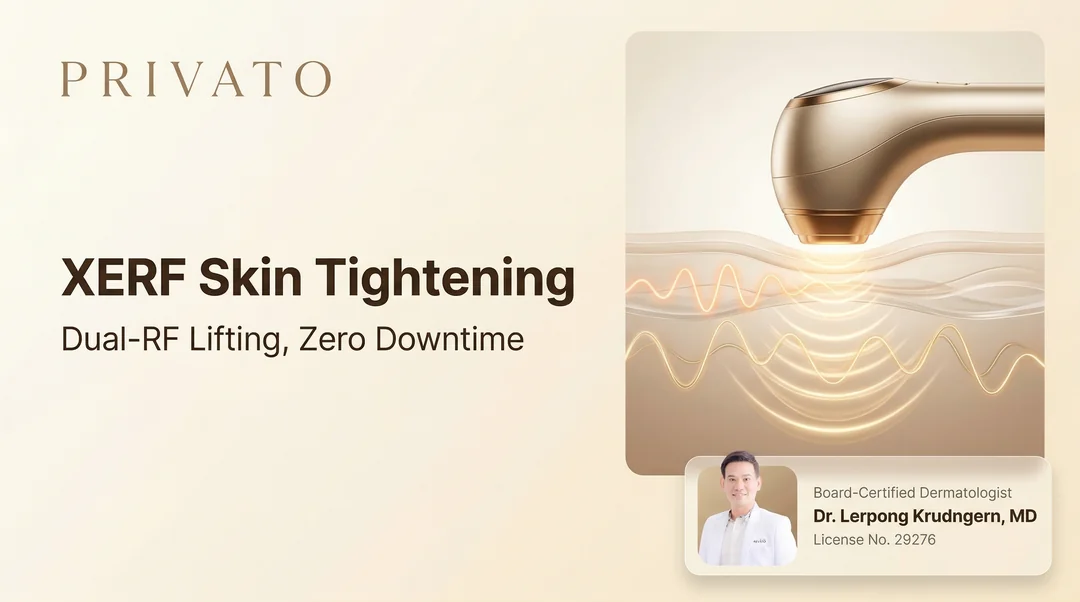
XERF Bangkok is a non-invasive structural skin tightening treatment that uses dual-frequency monopolar radiofrequency to stimulate collagen remodeling, with 600-shot sessions typically costing around ฿46,472 at certified clinics.
What is XERF and How Does It Work for Skin Tightening in Bangkok?
XERF is a non-invasive structural skin tightening treatment that uses dual-frequency monopolar radiofrequency (RF) to coagulate soft tissue and stimulate collagen remodeling. In Bangkok clinics, the procedure is typically performed by medical doctors using a handpiece that delivers two specific frequencies: 6.78 MHz for high-power heating and 2 MHz for deeper structural effects, reaching layers such as the SMAS.
How XERF works for skin tightening:
- Volumetric Heating: The device drives energy from an active tip through the skin to a dispersive return pad, creating bulk heating in the dermal and fascial layers.
- Collagen Remodeling: Internal temperatures reach 50–70°C to trigger immediate collagen fiber shortening and long-term thickening, while surface cooling keeps the skin at or below 43°C for safety.
- Comfort Technology: It utilizes “Wave Fit” pulses and integrated cryogen cooling to manage heat sensation, often marketed as a “never-numb” procedure that does not require topical anesthetics.
- Bangkok Protocols: Treatments are usually sold by “shot counts” (e.g., 600 shots for a 40–60 minute session) and are positioned for patients with mild-to-moderate laxity seeking a no-downtime lifting effect.
The Science of XERF: Combining Dual-Frequency RF and Ultrasound Technology
Monopolar RF vs. Traditional Radiofrequency Treatments
XERF utilizes dual-frequency monopolar RF (6.78 MHz and 2 MHz) to provide deeper structural tightening compared to traditional single-frequency treatments. While standard monopolar RF devices like Thermage FLX or Oligio typically operate at a single 6.78 MHz frequency, XERF’s dual-frequency approach is designed to coagulate soft tissue and target the SMAS layer for lifting sagging tissues. Key differences include:
- Technology: XERF combines 6.78 MHz (up to 400 W) with 2 MHz (up to 300 W), whereas traditional systems like Oligio use only 6.78 MHz.
- Depth and Mechanism: Monopolar RF drives energy through the tissue to a distant return pad for volumetric heating, while bipolar or multipolar RF returns locally, resulting in a narrower heated volume and shallower functional depth.
- Comfort and Workflow: XERF features “Wave Fit” pulse modulation and integrated cryogen cooling, marketed as a “never-numb” procedure that eliminates the 1-hour topical anesthetic period often required by traditional RF treatments.
- Clinical Effects: Histological evidence shows that XERF’s dual-frequency delivery causes immediate collagen bundle thickening and shortening in both superficial and deep fascia, supporting an “upward pull” effect.
How Dual-Frequency Energy Stimulates Deep Collagen Production
Dual-frequency energy stimulates deep collagen production by delivering two distinct radiofrequency (RF) wavelengths to create volumetric heating across multiple tissue layers. The system utilizes 6.78 MHz (up to 400 W) and 2 MHz (up to 300 W) to reach internal target temperatures between 50°C and 70°C while maintaining the skin surface at or below 43°C through integrated cooling. This thermal dose triggers immediate collagen bundle shortening and thickening, followed by a long-term remodeling process where new collagen continues to rebuild over several weeks. Histological evidence indicates this dual-frequency approach can reach the superficial muscular aponeurotic system (SMAS) and deep fascia, providing structural tightening and an upward pull of sagging tissues.
Structural Lifting: Targeting Multiple Skin Layers Without Surgery
XERF is a non-invasive structural skin tightening treatment that uses dual-frequency monopolar radiofrequency (RF) to target multiple tissue layers, including the superficial muscular aponeurotic system (SMAS). By combining 6.78 MHz and 2 MHz frequencies, the device delivers volumetric heating to stimulate collagen remodeling and coagulation in both superficial and deep fascia. This dual-action approach aims to lift sagging tissues, such as jowls, while integrated cryogen cooling and “Wave Fit” pulse technology manage surface temperatures for patient comfort without the need for numbing. Histological evidence shows that these thermal doses (reaching 50–70°C internally) cause immediate collagen shortening and long-term thickening, with results typically improving over several weeks as the body rebuilds its structural support.
Key Benefits of XERF Treatment for Face and Body
Immediate Skin Firming and Long-term Rejuvenation
XERF provides immediate skin firming through collagen bundle shortening and achieves long-term rejuvenation by stimulating collagen remodeling over several weeks. The treatment uses dual-frequency monopolar radiofrequency (6.78 MHz and 2 MHz) to deliver volumetric heating to the dermis and SMAS layers, causing an “upward pull” and immediate tissue contraction. While initial tightening is often felt right after the session, the full restorative effects develop as the body continues to rebuild collagen, with improvements typically monitored through 30 days and beyond.
Non-Invasive Lifting Without Fat Loss or Volume Depletion
XERF skin tightening prevents fat loss and volume depletion by maintaining internal tissue temperatures below the threshold for lipolysis. While collagen remodeling and skin tightening occur between 42°C and 65°C, fat cells typically only begin to break down at temperatures of 65°C to 70°C or higher. To ensure a lifting effect without losing facial volume, the treatment uses the following mechanisms:
- Dual-Frequency Monopolar RF: The system combines 6.78 MHz and 2 MHz frequencies to target the dermis and superficial musculoaponeurotic system (SMAS) for structural tightening rather than fat reduction.
- Integrated Cooling (ICD): Cryogen delivery and real-time impedance feedback keep the skin surface at or below 43°C, protecting the epidermis while focusing energy on collagen fibers.
- Parameter Control: “No fat loss” is highly dependent on the specific energy levels and depth settings chosen by the practitioner; using lower thermal doses specifically targets collagen thickening and shortening.
- Volumetric Heating: Unlike treatments that create high-heat thermal coagulation points, XERF provides bulk heating to the tissue layers to stimulate a natural “upward pull” through collagen remodeling.
Pain Management: Why XERF is More Comfortable Than Older RF Technologies
XERF is more comfortable than older radiofrequency technologies because it utilizes an integrated cryogen delivery system and a specialized Wave Fit pulse to manage heat. These features allow the device to maintain the skin surface temperature at or below 43°C while delivering therapeutic energy to deeper layers, often eliminating the need for topical numbing. The system further enhances patient comfort through real-time impedance feedback and adjustable cooling levels that can be tailored to individual sensitivity.
XERF vs. Ultherapy vs. Thermage: Which Lifting Treatment is Right for You?
Choosing the right lifting treatment depends on whether you prefer volumetric skin tightening (XERF and Thermage) or deep structural lifting (Ultherapy).
While all three treatments are non-invasive, they utilize different technologies and targeting methods:
- XERF: Uses dual-frequency monopolar radiofrequency (6.78 MHz and 2 MHz) to provide “structural” tightening. It is marketed for its high comfort level, often requiring no numbing cream due to integrated cryogen cooling and “Wave Fit” pulse technology.
- Thermage FLX: A well-established single-frequency monopolar radiofrequency (6.78 MHz) treatment. It focuses on tightening the skin’s surface and smoothing wrinkles through bulk volumetric heating.
- Ultherapy: Uses microfocused ultrasound to create thermal coagulation points at specific depths (up to 4.5 mm), reaching the SMAS layer for a more significant “lift.” It is generally considered more intense than RF treatments, with results developing over 2–3 months.
Comparison Table
| Feature | XERF | Thermage FLX | Ultherapy |
|---|---|---|---|
| Technology | Dual-Frequency Monopolar RF | Monopolar RF | Microfocused Ultrasound |
| Primary Goal | Structural tightening & comfort | Skin tightening & smoothing | Deep tissue lifting |
| Pain Management | Integrated cooling (often no numbing) | Vibration & cooling (numbing common) | Topical numbing typically required |
| Depth | Multi-depth (RF) | Volumetric (RF) | Precise depths (1.5, 3.0, 4.5 mm) |
| Downtime | Minimal to none | Minimal to none | Minimal to none |
XERF is often positioned for patients with mild-to-moderate laxity and low pain tolerance, while Ultherapy is preferred for those seeking a more pronounced lift of the jawline or neck.
XERF vs. Thermage FLX: Comparing Monopolar RF Efficiency
XERF and Thermage FLX both utilize 6.78 MHz monopolar radiofrequency at up to 400 W, but XERF adds a secondary 2 MHz frequency (300 W) to support deeper structural tightening. While both devices use disposable tip systems and volumetric heating to stimulate collagen, they differ in energy delivery and comfort mechanisms:
- Frequency and Energy: Thermage FLX operates solely at 6.78 MHz with an energy range of 15–600 J. XERF uses dual-frequency (6.78 MHz and 2 MHz) with a 6.78 MHz energy range of 1–250 J.
- Efficiency and Coverage: Efficiency depends on tip size; XERF tips include a 4.86 cm² (60 tip) and 3.10 cm² option, while Thermage FLX offers a range of tips from 3 cm² to 16 cm².
- Comfort Technology: XERF features “Wave Fit” pulse modulation and integrated cryogen cooling designed for use without topical numbing, whereas Thermage FLX protocols often involve vibration and cooling but may still result in higher reported pain scores (3–5/10 for Thermage vs. 1–3/10 for XERF).
- Treatment Depth: XERF’s dual-frequency approach and specific histology suggest it can target the SMAS layer for deeper coagulation compared to standard single-frequency monopolar RF. (Cynosure Lutronic, 2025)
XERF vs. Ultherapy: Deep Tissue Lifting vs. Surface Tightening
XERF and Ultherapy differ primarily in their energy source and heating method, with Ultherapy providing precise deep-tissue lifting and XERF offering volumetric structural tightening. While Ultherapy uses microfocused ultrasound to create thermal coagulation points at specific depths (1.5mm, 3.0mm, and 4.5mm) to target the SMAS layer, XERF utilizes dual-frequency monopolar radiofrequency (6.78 MHz and 2 MHz) to provide bulk volumetric heating across multiple tissue layers.
Key differences between the two treatments include:
- Technology: Ultherapy uses ultrasound energy with real-time visualization, whereas XERF uses radiofrequency current and a dispersive return pad.
- Temperature: Ultherapy reaches higher temperatures (60–70°C) for targeted lifting, while XERF maintains surface temperatures ≤43°C while heating internal targets to 50–70°C for collagen remodeling.
- Comfort and Downtime: XERF is marketed as a “no-numbing” procedure due to integrated cryogen cooling and pulse modulation, while Ultherapy often involves higher pain scores (mean 4.50) but results that can last over a year.
- Results: Ultherapy results typically develop over 2–3 months for a lifting effect; XERF can provide an immediate “tighter feeling” through collagen contraction, with continued remodeling over subsequent weeks
XERF vs. Oligio: Choosing the Best Korean Lifting Innovation
XERF and Oligio are both Korean-developed monopolar radiofrequency (RF) treatments, but XERF distinguishes itself by using dual-frequency technology (6.78 MHz and 2 MHz) compared to Oligio’s single-frequency (6.78 MHz) approach. While both devices target skin tightening through volumetric heating and collagen remodeling between 40–60°C, their clinical focus and comfort protocols differ:
- Technology: XERF utilizes dual frequencies to target both superficial and deeper structural layers, including the SMAS, whereas Oligio focuses on a single 6.78 MHz frequency for deep dermal heating.
- Comfort and Numbing: XERF is marketed with a “Never-Numb” workflow using integrated cryogen cooling and Wave Fit pulses to manage pain without topical anesthetics. In contrast, Oligio protocols often involve applying topical anesthetic under occlusion for up to one hour before the procedure.
- Safety Features: Both devices feature real-time impedance feedback and cooling systems to maintain skin surface temperatures at safe levels (typically ≤43°C) while delivering higher energy to internal targets.
- Treatment Experience: XERF sessions are generally positioned as faster “no-numbing” procedures, while Oligio is a well-established single-frequency alternative that provides similar collagen-stimulating results with a more traditional preparation phase.
Is XERF the Right Choice for Your Skin Concerns?
XERF is an ideal choice for individuals with mild-to-moderate skin laxity, such as sagging jowls or a softening jawline, who prioritize a comfortable treatment with no downtime. This dual-frequency monopolar radiofrequency (RF) system uses 6.78 MHz and 2 MHz to provide structural skin tightening by heating deep tissue layers while keeping the surface cool.
Consider XERF if your needs align with the following:
- Target Concerns: It is specifically designed for lifting sagging lower-face tissues and tightening the periorbital (eye) area through collagen remodeling.
- Pain Tolerance: It is marketed as a “never-numb” procedure, using Wave Fit pulse technology and integrated cryogen cooling to maintain comfort without topical anesthetics.
- Convenience: Sessions typically last 40–60 minutes, and patients can resume daily activities immediately, as side effects are generally limited to transient redness or mild swelling.
- Safety Profile: It is suitable for those seeking non-invasive options, though it is contraindicated for individuals who are pregnant, have pacemakers, or have metal implants in the treatment area.
Ideal Candidates for XERF Structural Lifting
Ideal candidates for XERF are individuals with mild-to-moderate skin laxity, particularly those in their late 30s to 50s experiencing early jowls or a softening jawline.
This treatment is specifically suited for patients who:
- Seek non-invasive lifting: It is positioned as a “no downtime” alternative for structural skin tightening without the need for surgery.
- Have low pain tolerance: XERF is marketed for its comfort, often requiring no topical numbing due to integrated cooling and pulse modulation technologies.
- Desire gradual improvement: While some immediate tightening may occur, the primary results develop over several weeks as collagen rebuilds.
- Lack contraindications: Candidates must not be pregnant, breastfeeding, or have implanted electronic devices (like pacemakers), metal hardware in the treatment area, or active skin diseases.
Expected Results: When Will You See the Full Effect?
Full results from XERF skin tightening typically develop over several weeks as collagen continues to rebuild, though some immediate contraction may be visible. While an initial “tighter feeling” or “upward pull” can occur right after the session due to immediate collagen bundle shortening, histological evidence shows that remodeling and thickening of the superficial and deep fascia progress through at least 30 days. Clinical protocols often monitor improvements at one and three-month intervals to track the gradual lifting of sagging tissues.
Recommended Number of Sessions for Optimal Results
The recommended frequency for XERF treatment typically involves a single initial session, with results developing as collagen rebuilds over the following weeks and months. While immediate tightening may be felt, the full lifting effect from collagen remodeling continues for at least 30 days and up to three months. Because long-term comparative data is still limited, some providers may suggest follow-up sessions based on individual aging concerns, though many clinics position it as a “no downtime” procedure with results that can last significantly longer than the initial healing phase
XERF Treatment in Bangkok: Pricing and Clinic Selection
Average Cost of XERF (600 Shots) in Bangkok Clinics
The average cost for a 600-shot XERF treatment in Bangkok is approximately ฿46,472, based on current clinic offerings. Prices typically range from a promotional low of ฿35,900 to around ฿49,999 for a single session. These appointments generally last between 40 and 60 minutes and are performed by medical doctors. (Bangkok implementation and pricing, 2026)
How to Choose a Certified XERF Provider in Thailand
To choose a certified XERF provider in Thailand, verify that the clinic uses authentic Cynosure Lutronic equipment and employs medical doctors to perform the procedure.
Follow these steps to ensure a safe and certified treatment:
- Confirm Equipment Authenticity: Ensure the device is a genuine Cynosure Lutronic XERF system rather than a generic “dual RF” machine. You can request to see sealed, brand-matched consumables (tips) before the session.
- Check Distributor Verification: Look for clinics supported by Aestellar, the exclusive aesthetic distributor for XERF in Thailand, which provides clinical support and after-sales evaluation.
- Verify Practitioner Credentials: Confirm that a medical doctor designs the treatment plan and delivers the pulses, as specialized knowledge is required to manage depth distribution and impedance feedback.
- Review Safety Protocols: Ensure the clinic follows a standardized contraindication checklist (excluding patients with pacemakers or metal implants) and provides a clear aftercare plan involving SPF 50 and heat avoidance.
- Evaluate Pricing and Transparency: Compare 600-shot packages, which typically range from ฿35,900 to ฿49,999 in Bangkok, and confirm if the price includes a professional consultation and follow-up imaging.
What to Expect During Your XERF Appointment
During a XERF appointment, you can expect a non-invasive skin tightening procedure lasting approximately 40 to 60 minutes that involves volumetric heating and integrated cooling for comfort.
The typical treatment process includes the following steps:
- Preparation: The clinician cleanses the target area, applies a dispersive return pad to your body, and uses an ultrasound coupling gel on the skin.
- Energy Delivery: A medical doctor uses a specialized handpiece to deliver dual-frequency monopolar RF pulses (6.78 MHz and 2 MHz) across mapped vectors of the face or neck.
- Sensation: You will feel deep warmth as the device targets tissue layers, which is moderated by Wave Fit pulse technology and integrated cryogen cooling; most protocols do not require topical numbing.
- Immediate Aftermath: You may experience mild redness (erythema), warmth, or slight swelling that typically resolves within a few hours.
- Post-Care: There is no downtime, allowing for an immediate return to daily activities, though you should avoid saunas and strenuous exercise for 48 hours and apply SPF 50.
Safety, Side Effects, and Post-Treatment Care
Common Side Effects: Redness and Temporary Swelling
Common side effects of XERF treatment include transient redness (erythema), mild swelling (edema), and a feeling of warmth or tingling. These symptoms are typically mild and resolve within a few hours of the procedure. To manage these effects, patients are advised to avoid heat, saunas, and strenuous activity for 48 hours while applying non-irritating moisturizer and broad-spectrum SPF 50.
Who Should Avoid XERF? Contraindications and Warnings
Individuals with implanted electronic devices, metal hardware in the treatment area, or who are currently pregnant or breastfeeding should avoid XERF.
According to clinical protocols and manufacturer safety guidelines, the primary contraindications for XERF skin tightening include:
- Implanted Medical Devices: This includes pacemakers, defibrillators, neurostimulators, and cochlear implants.
- Metal Hardware: Any metal implants that could interfere with the flow of the radiofrequency current.
- Active Skin Conditions: Individuals with active dermatologic diseases, a history of keloid scarring, or impaired wound healing.
- Recent Procedures: Those who have had injectable treatments (like Botox or fillers) in the target area within the last six months may need to delay treatment to avoid risks.
Common temporary side effects include mild redness (erythema), warmth, swelling (edema), or tingling, most of which typically resolve within a few hours
Aftercare Tips to Maximize Your Collagen Stimulation
To maximize collagen stimulation and ensure proper healing after XERF treatment, avoid high-heat environments, strenuous activities, and skin irritants for at least 48 hours. Following these restrictions helps manage transient redness and swelling while the deeper tissue begins the remodeling process.
Key aftercare steps include:
- Sun Protection: Apply broad-spectrum SPF 50 sunscreen immediately and consistently throughout the following months.
- Hydration: Use a non-irritating moisturizer to support the skin barrier.
- Temperature Control: Avoid hot showers, saunas, and steam rooms for the first two days.
- Activity Modification: Refrain from intense exercise for 48 hours to prevent excessive localized heat.
- Product Safety: Do not use irritating topical treatments or exfoliants during the initial recovery period.
Why Choose Privato Clinic for XERF in Bangkok?
Privato Clinic is a choice for XERF in Bangkok because it offers doctor-designed treatment plans starting at ฿9,900 across multiple branches. The clinic positions XERF as a more comfortable alternative to Thermage, citing an average pain score of 1–3/10 compared to Thermage’s 3–5/10, along with faster resolution of post-treatment redness. Their protocols utilize the 6.78+2 MHz dual-frequency technology, Wave Fit pulses, and integrated cryogen cooling to provide “no-numbing” sessions focused on collagen stimulation and skin tightening.
Certified XERF provider with authentic dual-frequency RF equipment
To find a certified XERF provider in Bangkok, verify the clinic uses authentic Cynosure Lutronic equipment and sources consumables through Aestellar, the exclusive distributor in Thailand. While a manufacturer “Find a provider” locator exists, patients should specifically request brand-matched, sealed consumables and confirm the treatment is performed by a medical doctor to ensure safety and efficacy. In Bangkok, clinics such as The Signature Clinic, Aestima, DSK, and Privato offer XERF treatments, typically featuring 600-shot protocols and “Never-Numb” workflows that utilize integrated cryogen cooling.
Experienced aesthetic doctors specializing in structural lifting
Experienced aesthetic doctors in Bangkok provide XERF structural lifting treatments through personalized protocols that utilize dual-frequency monopolar RF technology. These medical professionals design treatment plans—often involving 300 to 600 shots—to target sagging tissues like the jowls by coagulating soft tissue and the SMAS layer. Clinics such as The Signature Clinic, Aestima, DSK, and Privato employ doctors to oversee these 40–60 minute sessions, ensuring safety through real-time impedance feedback and integrated cooling systems.
Personalized shot count and treatment plans for each patient
XERF treatment plans are personalized through adjustable depth settings, intensity levels, and regional dosing protocols tailored to a patient’s specific anatomy and laxity. Doctors typically determine shot counts based on the treatment area, with common heuristics in Bangkok clinics estimating 300–400 shots for a full face and approximately 500 shots for the face and neck combined. To ensure safety and comfort, practitioners utilize real-time impedance feedback for skin analysis and can adjust integrated cryogen cooling across three levels. Specialized protocols, such as those for the periorbital region, may further refine plans by using different tip sizes and energy levels (typically 4–6) to target delicate tissues effectively.
FAQs About XERF Treatment in Bangkok
Is XERF painful compared to other RF treatments?
No, XERF is generally described as more comfortable than other radiofrequency (RF) treatments due to its integrated cooling and pulse modulation technologies. While pain perception varies by individual and settings, XERF is marketed as a “never-numb” procedure that often does not require topical anesthetics. Its Wave Fit pulse technology and integrated cryogen delivery cooling system are designed to manage heat at the skin’s surface, resulting in a reported average pain score of 1–3 out of 10, compared to 3–5 out of 10 for Thermage.
How long do the results of a XERF session last?
The exact duration of XERF results is currently unconfirmed by long-term clinical studies, though marketing materials often suggest a persistence of 12 to 18 months. While immediate skin tightening occurs due to collagen contraction, the full lifting effect develops over several weeks as the body continues to rebuild collagen. Current clinical protocols have documented follow-up results for up to three months, but larger studies are required to verify the long-term longevity of the treatment
Can I combine XERF with Botox or Dermal Fillers?
You should disclose any recent or planned injectables to your provider, as some protocols recommend spacing these treatments to avoid localized overheating or confounding results. While XERF is often marketed as a no-downtime procedure, specific clinical protocols for delicate areas have excluded patients who received periorbital procedures within the previous six months. To ensure safety and optimal outcomes, it is best to discuss a personalized treatment timeline with a medical professional to reduce the risk of interfering with the placement or longevity of Botox and fillers.
Is there any downtime after a XERF procedure?
No, there is typically no downtime after a XERF procedure, and patients can resume daily activities immediately. While the treatment is non-invasive, some individuals may experience mild, transient redness, warmth, or slight swelling that usually resolves within a few hours. To ensure proper recovery, it is recommended to avoid hot showers, saunas, and strenuous exercise for 48 hours while applying moisturizer and SPF 50 sunscreen. (XERF Patient Brochure, Cynosure Lutronic, 2025)